
Vinca: The Neolithic Site on Belgrade's Doorstep
Vinca's Belo Brdo site is 14 km downstream from Belgrade (16 km by road): 2026 hours, tickets, what the small museum shows, and how to get there.
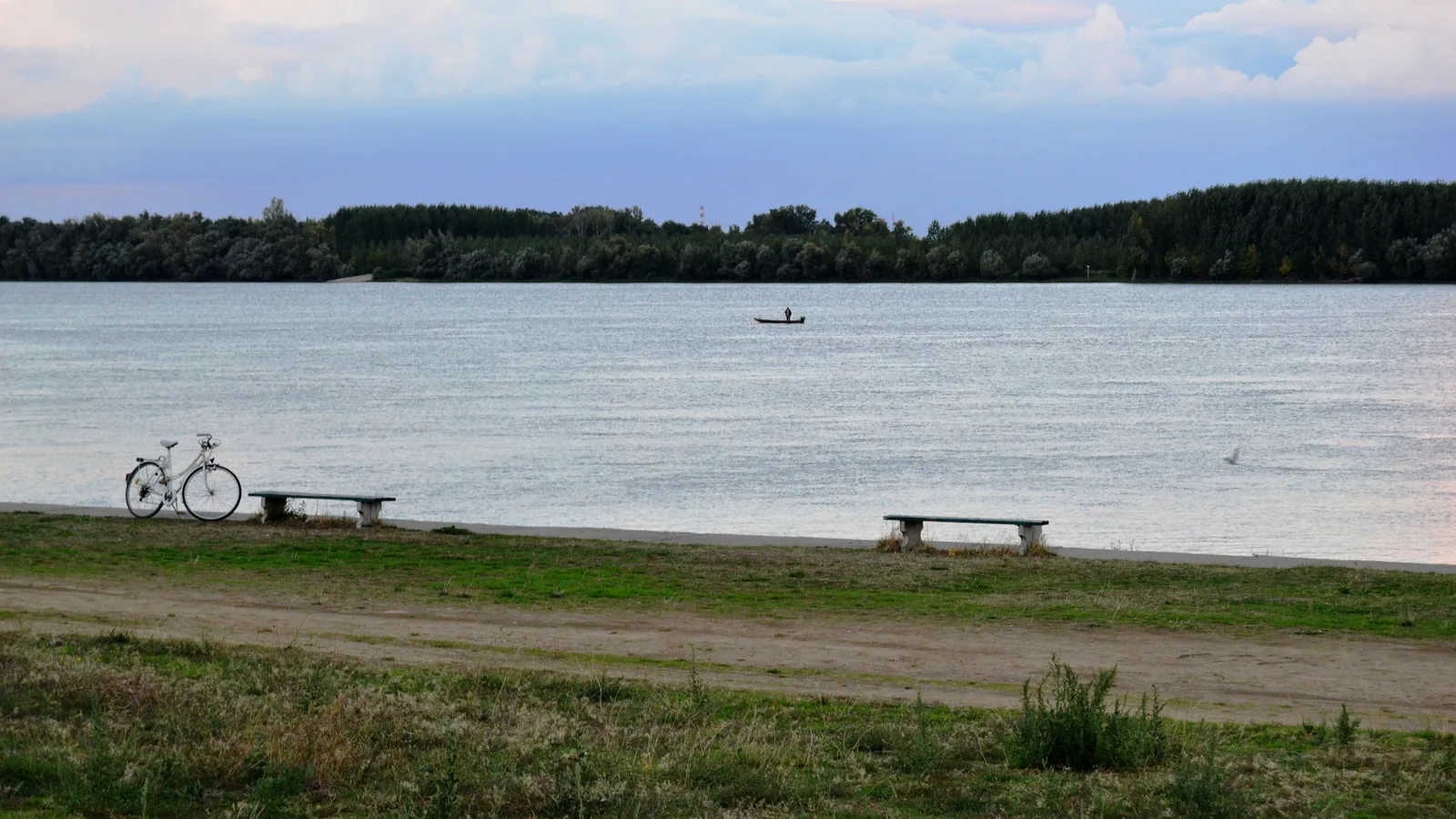
Fourteen kilometres downstream from central Belgrade, a low bluff over the Danube gave its name to an entire stretch of European prehistory: the Vinča culture, whose type-site is a Neolithic settlement called Belo Brdo, with a small museum built beside the dig. It’s a half-day add-on to a Belgrade trip, not a full day out like Lepenski Vir further down the Iron Gate gorge, and it runs on a seasonal calendar - open April through October, by appointment only outside those months. Get the timing right and it’s a serious, well-documented site worth an hour or two; get it wrong and you’ll be turning up at a locked gate.
A riverbank that named a civilisation
Vinča gets a mention in every serious book on European prehistory because it’s the type site - the place that lent its name to the whole Vinča culture, a Late Neolithic and Copper Age tradition that spread across the central Balkans and into parts of Hungary and Romania, roughly 5300 to 4500 BC. People had farmed this bend of the Danube even earlier: Starčevo-culture settlers arrived around 5700-5500 BC - sources round that date differently - laying down the first layers of what became a very tall pile of history.
“Very tall” undersells it slightly. The mound - a tell, in archaeology-speak, built up from generation after generation of collapsed and rebuilt mudbrick houses - covers about 10 hectares and holds roughly 9 metres of stratified Neolithic and Copper Age deposits, for a total rise of around 10.5 metres above the surrounding floodplain. You can see that profile up close: erosion along the riverbank has sliced a rough cross-section straight through part of the mound, and it’s also why the site needed rescuing. The Serbian government has committed more than 3 million euros to Belo Brdo’s rehabilitation over several years; the first phase, reinforcing the eroding bank with piles between 2021 and 2023, was part-funded by a $475,000 grant from the US Ambassador’s Fund for Cultural Preservation.
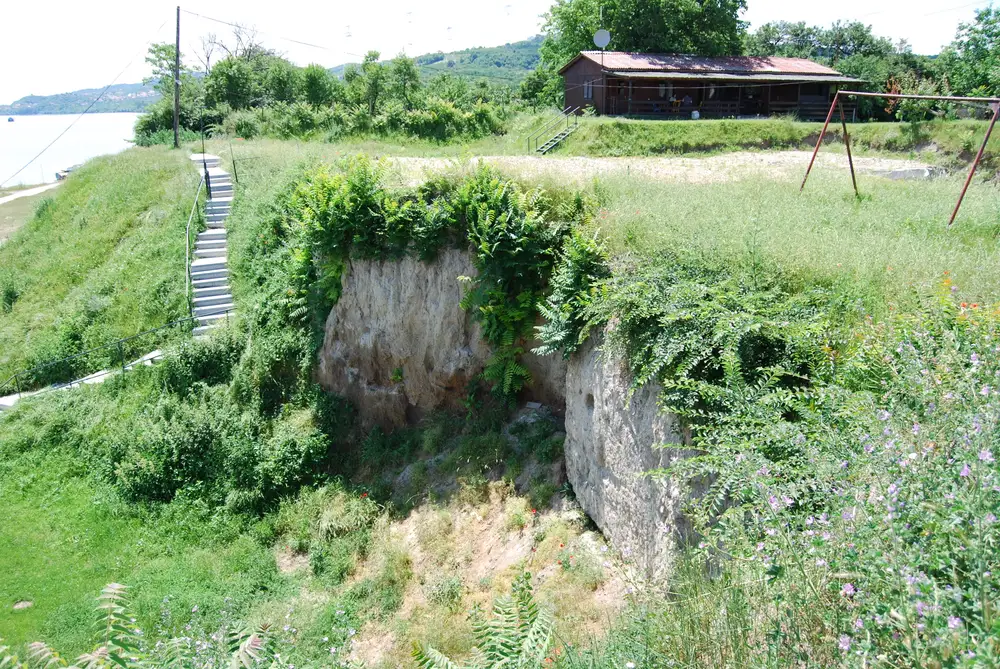
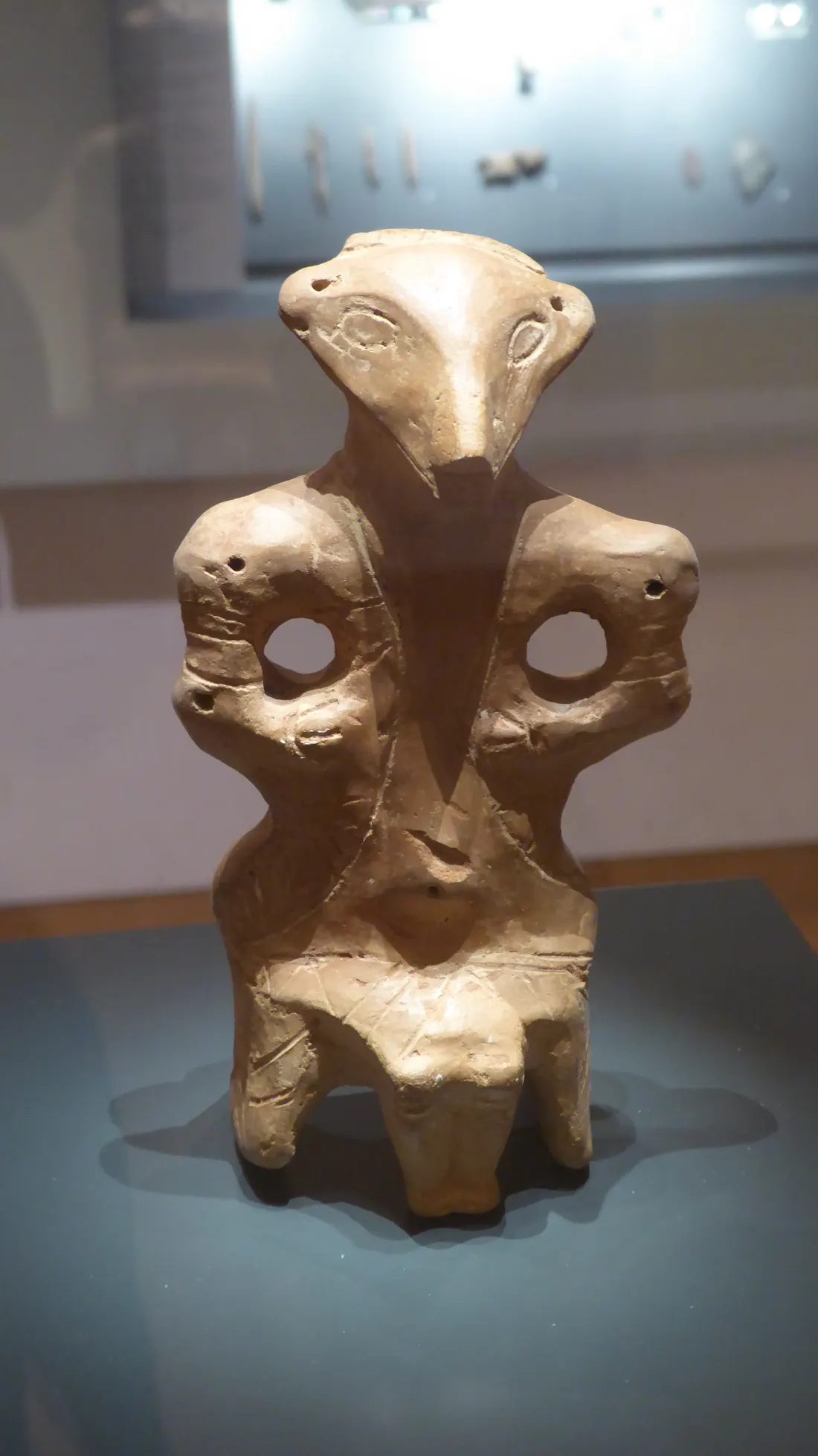
The site’s own operator doesn’t undersell it, either. The Belgrade City Museum’s visitor page for Vinča claims the settlement became “the largest market in Europe” of its age, sitting at a crossroads of river and land routes and pulling in raw materials from as far as Transylvania, the lower Danube, and the Adriatic and Aegean coasts. The museum’s own Vinča-culture microsite goes further, crediting the site with the world’s earliest known extractive copper metallurgy. Both are institutional claims rather than scholarly consensus, and the state’s own materials don’t line up behind them: the official Google Arts & Culture story on the site makes neither, while the government project page for Belo Brdo’s restoration calls it the first place metal smelting happened. The finds do back up the general picture, though: more than 1,000 clay figurines, plus amulets, altars, and tens of thousands of pottery fragments have come out of the ground, from houses that were rectangular, built of wattle and daub, sometimes with an attic space, and packed together in orderly rows rather than scattered at random.
A century of digging, on and off
The excavation history is almost as interesting as what’s buried. Miloje Vasić, the first archaeologist formally trained in Serbia, opened the first trenches in 1908 and worked, with interruptions, into the early 1930s; World War I shut the dig down for years, and a British-funded team - backed by the businessman-archaeologist Charles Hyde - picked it back up on a larger scale between 1929 and 1931, work that drew enough attention to send Vinča finds to the Ashmolean and British Museums in the UK. A campaign under the Serbian Academy of Sciences and Arts ran from 1978 to 1986, split between Bronze Age layers (led by Nikola Tasić and Gordana Vujović) and the more famous Neolithic occupation (led by Dragoslav Srejović). Since 1998, a University of Belgrade team led by Nenad Tasić has kept working the site with newer techniques. None of that means you’ll find archaeologists in open trenches on the day you visit: fieldwork runs in short scheduled seasons, and what greets visitors is the finished exhibition, not a live dig.
What you’ll find inside
Set your expectations correctly and Vinča is genuinely worthwhile; go in expecting a hilltop-castle spectacle and you’ll be let down. There’s no reconstructed Neolithic village to wander through. What’s here instead is a compact permanent exhibition - display cases of pottery, figurines, and tools alongside photographs from the various excavation campaigns - built next to the excavated stretch of the mound, plus a riverside path where you can walk to see the exposed tell profile for yourself. That path is uneven ground, not a paved walkway - and the museum’s own site is blunt that the locality as a whole, not just the path, isn’t currently suitable for visitors with physical disabilities.
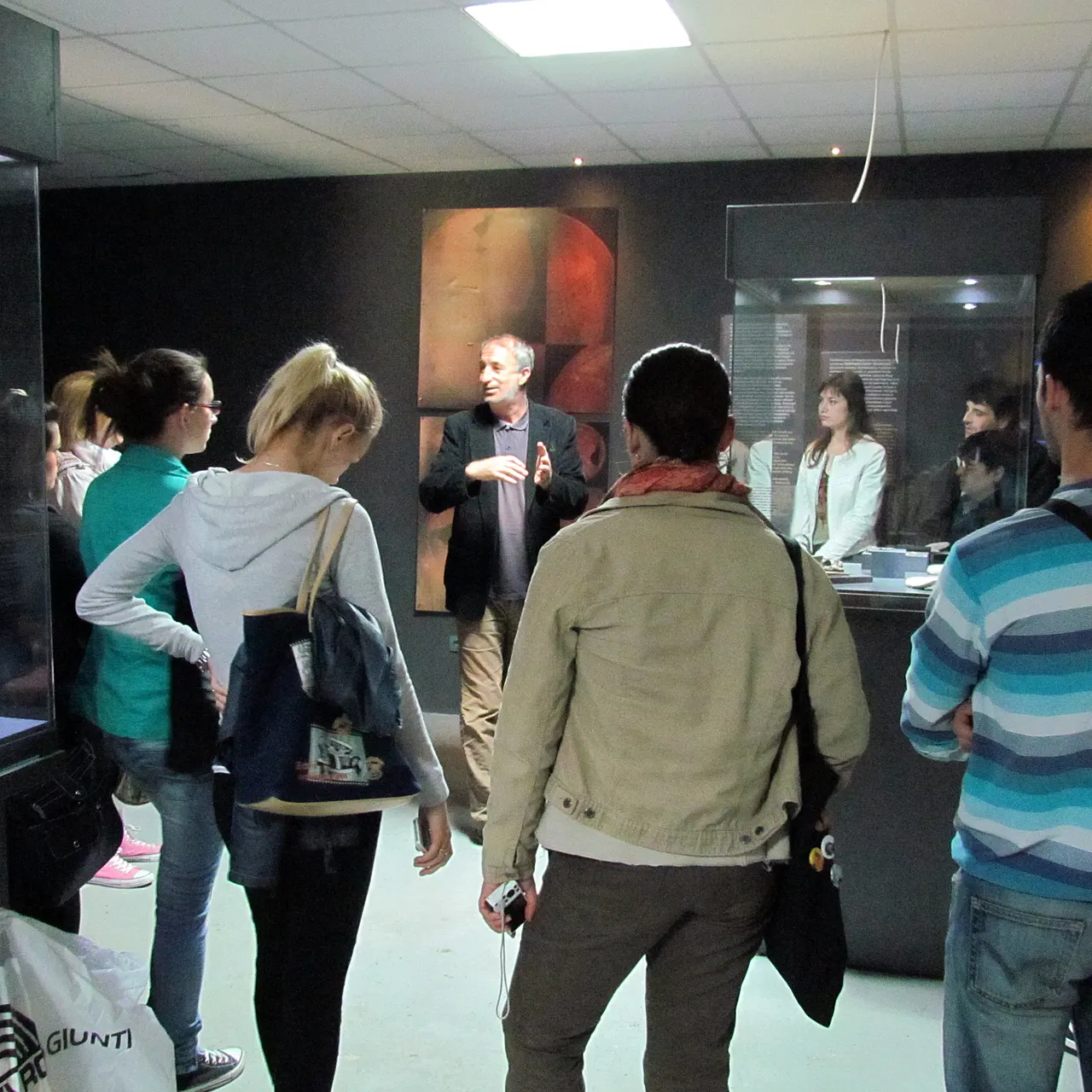
The museum runs guided tours on weekends (10:00, 11:30, 13:00, 14:30, 16:00, and 17:30 as of the 2026 season), and they’re worth planning around. Dragan Janković, the museum’s curator for the site - his own email address is the one listed for visitor enquiries - walks groups through the cases and the excavation itself; a printed label only goes so far with material this old.
Don’t rush past the pottery cases: watch for the zoomorphic vessels - jugs and bowls with an animal’s face or snout worked into the clay - next to plainer three- and four-legged bowls that show real technical control for something this old. The figurines, Vinča’s most famous export, are stylised and a little unsettling: elongated heads, mask-like faces, and in some pieces what look like two smaller heads growing from a single seated body.
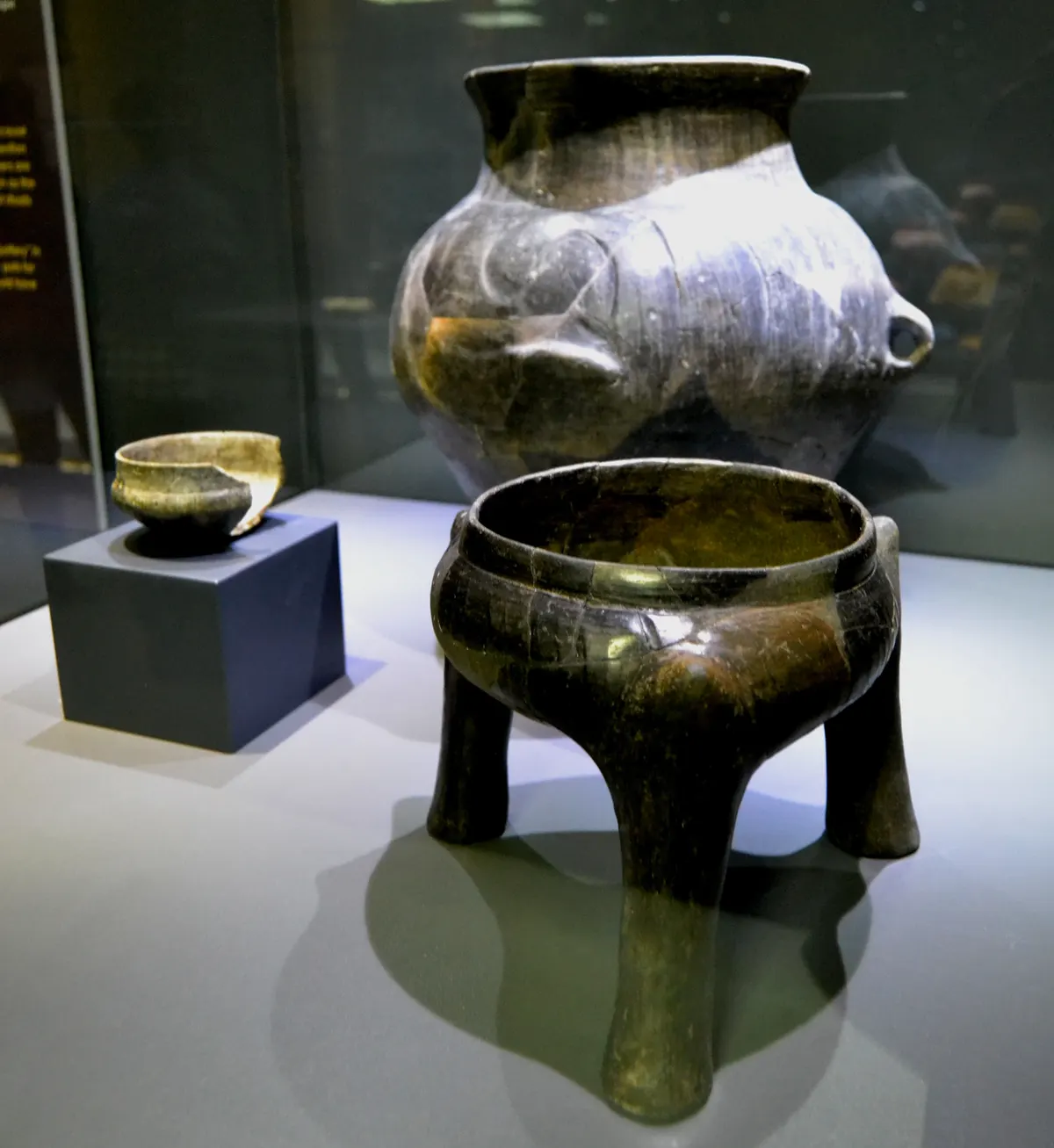
The Vinča symbols: the world’s oldest writing? Probably not
You’ll sometimes see Vinča described online as the birthplace of writing, centuries before Sumerian cuneiform. That claim rests on the so-called Vinča symbols: short, repeated marks scratched into pottery and figurines, most dated to roughly 4500-4000 BC. Hold it loosely: mainstream archaeological opinion considers it “unlikely that they represent a writing system” at all. Most researchers read the marks as potters’ identification marks or symbolic notation, not an attempt to record spoken language - there’s no sign of the grammar-like structure that real writing needs. A minority position, linked to archaeologist Marija Gimbutas, argues for a genuine “Old European script”, met mostly with scepticism. Treat it as an open question, not a settled fact.
How Vinča compares to Lepenski Vir
Serbia has two prehistoric Danube sites that come up in the same conversations, but they’re different cultures on a different scale. Lepenski Vir, covered in full inside our Iron Gate and Golubac guide, is older and separate: a Mesolithic-into-Neolithic settlement occupied roughly 9500-5500 BC, famous for haunting fish-and-human carved boulders and stone-built houses from around 6300-6000 BC, its excavated dwellings now under a glass-roofed museum hall deep in the Iron Gate gorge.
Here at Belo Brdo, the Vinča-culture layer dates to roughly 5200-4500 BC (the wider culture runs 5300-4500 BC) - a separate, later chapter of the same Danube prehistory, not a continuation of Lepenski Vir. Lepenski Vir wins on spectacle and the full gorge experience; Vinča wins on not costing you a whole day.
Opening hours, tickets, and the season that matters
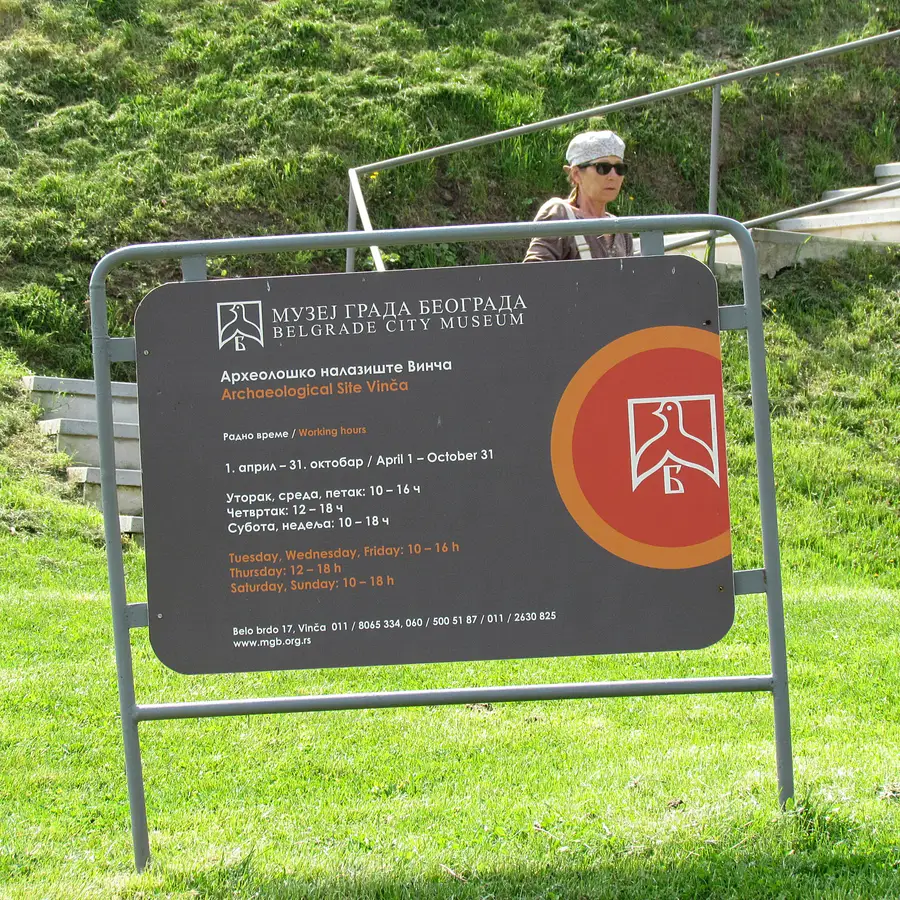
One detail decides whether your visit works at all: Vinča runs on a seasonal schedule. From April 1 through October 31, it’s open Tuesday, Wednesday, and Friday 10:00-16:00, Thursday 12:00-18:00, and Saturday-Sunday 10:00-18:00; Monday is a closed day. Outside that window, from November through March, you can still get in, but only by advance booking.
Tickets are cheap by any measure: 300 RSD for adults, 150 RSD for pupils, students, unemployed visitors, and pensioners. Entry is free for children under 7, for disabled visitors bringing an assistant (though see the access warning above), and for holders of EURO<26, ISIC, or MDS/ICOM cards. Larger groups get two free tickets for every ten full-price visitors - the deal doesn’t stack with the concession rate. If your schedule is flexible, the last Saturday of every month is free admission for everyone. These figures come from the museum’s live Serbian-language page; two English pages for the site still show the old 200/100 figure, so re-check before you travel. Call +381 60 500 51 87 to lock in a guided-tour slot; there’s free parking on site if you’re driving.
Bus, taxi, or a paired tour: getting there without a car
Which option makes sense depends on whether you have a car and how much time you want to spend working out a route.
By public transport, city bus 307 runs the full Ustanička-Vinča line, ending at a stop simply called “Vinča”, with “Vinča school” and “Vinčanska” closer to the site - and it’s free, just like Belgrade’s public transport generally, no ticket or card needed. Ustanička is a tram and bus interchange in Zvezdara, not downtown, so factor in time to get there first; the leg itself takes roughly half an hour by transit-app estimate, and the city timetable runs the 307 about every twelve minutes on a weekday, so you won’t wait long at the terminus.
By car or taxi, don’t go by the “14 km” you’ll see quoted for Vinča - that’s the straight-line, downstream distance the operator itself uses. The actual drive from the city centre runs closer to 16-17 km and 25-30 minutes, once you follow the river road round rather than cut across it. Running that against Belgrade’s official metered day tariff (a 320 RSD flag plus 105 RSD per km) works out to somewhere around 2,000-2,100 RSD, call it 17 EUR. Treat that as a floor. The city’s taxi rules price a ride partly by whether it stays in the inner zone or crosses into the outer one, and nothing the city publishes says which side Vinča - out in Grocka, on the rim of Belgrade’s territory - falls on. Some drivers apply the 210 RSD/km out-of-town rate here, which roughly doubles the bill, to about 3,800 RSD. Agree the fare before you set off, or book through an app that quotes the whole trip up front.
If you’d rather not manage any of that, the scheduled option here is the museum’s own weekend tour on site, not a coach out of Belgrade the way there is for Golubac and the Iron Gate. What the tour market sells instead is private, customisable trips that pair Vinča with the Roman site of Viminacium for a longer day out - a sensible pick for travellers who’d rather have a guide than juggle bus transfers.
Budget half a day, then decide what comes next
Most people are done inside an hour: the exhibition room, then a walk along the riverside path to see the mound’s profile. Add the guided tour and you’re closer to ninety minutes, which is the version worth choosing if your dates line up with a weekend. Either way, Vinča stays a half-day loop from Belgrade, not something that eats your whole itinerary.
Pairing options depend on your appetite for prehistory. Want more of it? The private Vinča-and-Viminacium tours mentioned above bundle Roman ruins with a Neolithic type-site in one long day. Want to balance it against the city instead? Treat Vinča as a morning trip and spend the afternoon back in the centre - our Belgrade city guide covers Kalemegdan, Skadarlija, and everywhere else worth a stop, and our roundup of the best day trips from Belgrade lines Vinča up against Smederevo, Novi Sad, and the Iron Gate run so you can decide which one earns your day off.
Go in with the right expectations - and ideally with a guided-tour slot booked - and it delivers: a serious, well-documented excavation with a small museum wrapped around it, and a curator who turns display cases into a story the labels alone don’t tell.
Photos
On the map
The map loads on click - to keep the page lightweight.
The map didn’t load. Check your connection and refresh the page.
Admission and opening hours
- Admission price
- Adults 300 RSD; pupils/students/unemployed/pensioners 150 RSD; free under 7, disabled visitors with an assistant, and EURO<26/ISIC/MDS/ICOM cardholders; groups get two free tickets for every ten full-price visitors (not on the concession rate); free for everyone on the last Saturday of each month
- Opening hours
- Open April 1-October 31: Tue/Wed/Fri 10:00-16:00, Thu 12:00-18:00, Sat-Sun 10:00-18:00, closed Monday. Nov-Mar: advance booking only
Weekend guided tours at 10:00, 11:30, 13:00, 14:30, 16:00 and 17:30 - call +381 60 500 51 87 to book a slot. Re-check before you go, and use the museum's own mgb.org.rs page for the price: the vincaculture.rs one still lists the old figure. Free car park on site.
Details checked: August 29, 2026
Distance ≈16 km · 25-30 min by car or taxi; bus 307 (from Ustanička) runs about 30 min for that leg alone
- Belgrade ≈16 km · 25-30 min by car or taxi; bus 307 (from Ustanička) runs about 30 min for that leg alone Bus 307 is free, part of Belgrade's fare-free public transport, but it starts at Ustanička rather than downtown. The only city-centre line, night bus 307N from Studentski trg, runs twice after midnight. Taxi or a private tour paired with Viminacium are the easier non-driving options - see Getting there.
Read also

What to see · 10 min read
Skull Tower of Niš: Story, Tickets, Visiting Tips
Verified · August 25, 2026Ćele Kula in Niš: 1809 Battle of Čegar, chapel hours, 300 RSD tickets and how to visit respectfully from the centre or INI airport.

What to see · 10 min read
Smederevo Fortress: Giant on the Danube
Verified · August 23, 2026Smederevo Fortress on the Danube: the 1428-1430 last capital of medieval Serbia, tickets, buses from Belgrade and pairing it with a Danube road trip.

What to see · 8 min read
Museum of Yugoslavia: House of Flowers Guide
Verified · August 21, 2026Belgrade Museum of Yugoslavia tickets and hours, House of Flowers (Tito), May 25 Museum and how to reach Dedinje.

What to see · 12 min read
Ada Ciganlija: Belgrade's River Island Beach
Verified · August 15, 2026How to reach Ada Ciganlija, when Lake Sava is lifeguarded, what you pay for, and where to swim on Belgrade's river-island beach.