
Iron Gate & Golubac Fortress: Danube Day Trip Guide
The Iron Gate gorge and Golubac Fortress east of Belgrade: Europe’s largest river gorge, a restored medieval castle, Lepenski Vir and boat cruises.
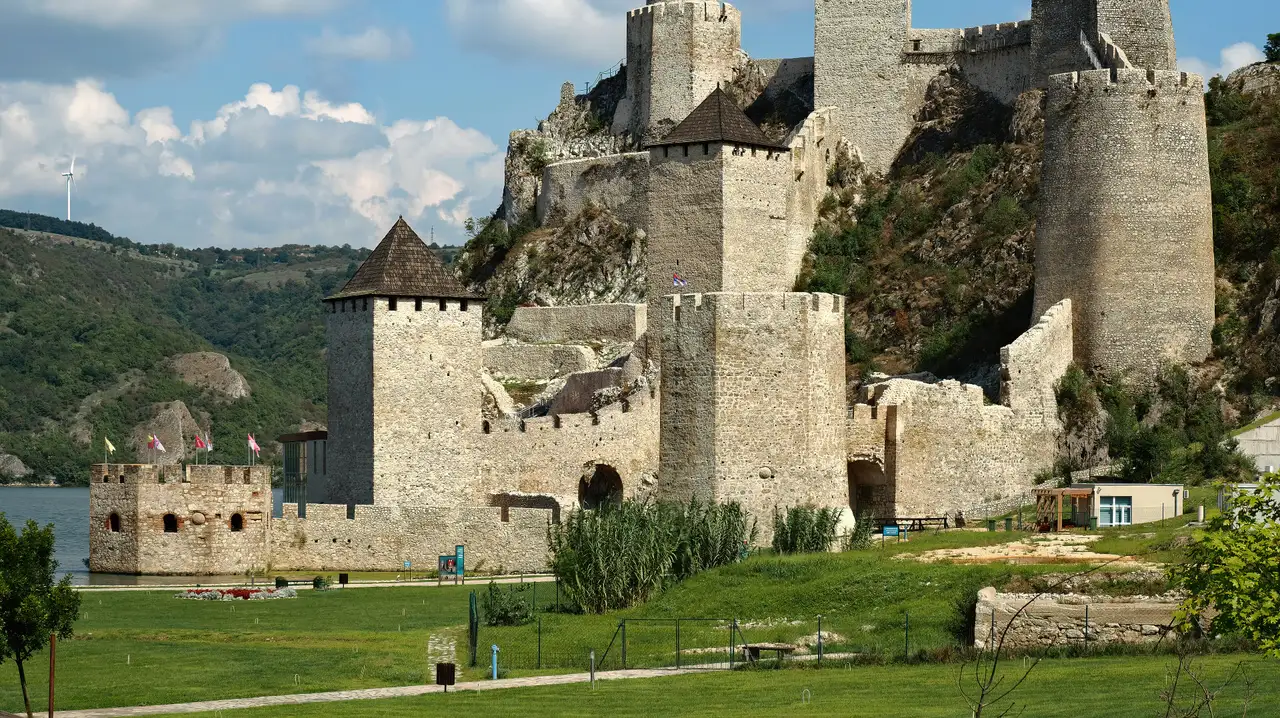
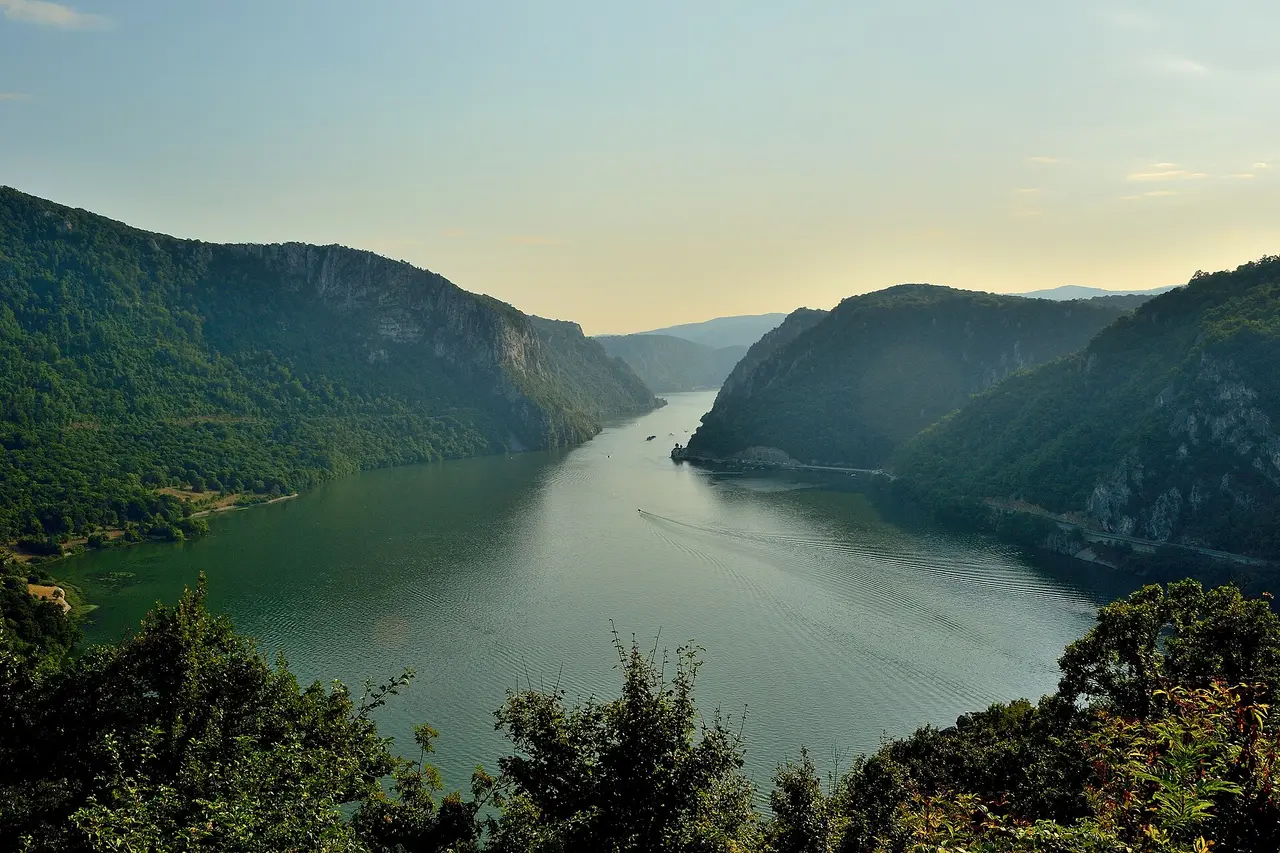
The Iron Gate is where the Danube stops being a lazy plain river and turns into something else entirely: a 134-kilometre chain of gorges where Europe’s second-longest river carves between the Carpathian and Balkan mountains, dropping to its deepest and squeezing to its narrowest along the border between Serbia and Romania. The set-piece at the western end is Golubac Fortress, a ten-towered medieval castle strung along the water that reopened in 2019 after a full restoration. It sits about 130 km east of Belgrade - a drive of roughly an hour and three-quarters to two hours - which makes it a genuine day trip, though you’ll want longer if you mean to go deep into the gorge.
One thing to get straight before you go: this isn’t a single sight but a string of them, spread along the river over a long, slow stretch of road. Golubac Fortress at the mouth is the easy day trip; push deeper and the gorge saves its best - the tightest narrows, the prehistoric carved faces of Lepenski Vir, and a Roman plaque and a Dacian king glaring at each other across the water - for those who give it more time and, in places, get on a boat.
Where is the Iron Gate, and can you do it as a day trip?
Short version: yes, Golubac and the near end of the gorge work as a day trip from Belgrade - but only just, and only if you’re organised about it. If that feels too far, Smederevo Fortress on the same river, about 60 km by road from Belgrade, is an easier half-day by bus. The gorge fortress is around 130 km east of the city, reached by driving down the Danube via Požarevac and Veliko Gradište, and Google’s optimistic hour-and-a-half is really closer to two hours once you factor in the slower stretches. That’s fine there and back in a day with time at the castle and a stop or two beyond.
What doesn’t fit in a day is the whole gorge. The Iron Gate runs 134 km down to the Iron Gate dam near Kladovo, and the best cruise narrows - the Kazan - and the Decebalus carving are another two hours’ drive past Golubac, deep into the park. Try to cram all of that plus the drive home into a single day and you’ll spend most of it in the car. If the gorge itself is the goal, base a night in Donji Milanovac or Kladovo and give it two days - our three-day Danube road trip from Belgrade to the Iron Gates maps the whole run, fortress by fortress.
A car makes all of this far easier. There are direct buses from Belgrade to Golubac (roughly two and a half hours), but the sights beyond the fortress are strung out along the river with no useful public transport between them, so without wheels you’re stuck at the castle. If you’d rather not drive - the road is long and the parking-then-boat logistics fiddly - an organised day tour is the sensible alternative, and it’s how a lot of people do it, bundling the fortress, the national park and a boat ride with someone else at the wheel.
Golubac Fortress: the castle at the mouth of the gorge
Golubac is the reason most people make the drive, and it earns it. The fortress stands on the Danube bank at the point where the river begins to narrow into the gorge - the water is still about six and a half kilometres wide here, so the setting is vast - with its towers and curtain walls stepping up a rocky spur straight out of the water. It’s the picture-book idea of a river castle, and after the 2019 works it’s in genuinely good shape rather than the romantic ruin it was for most of the last century.
The fortress went up early in the 14th century - the first written record is in Hungarian sources from 1335 - and nobody’s sure whether Serbs, Bulgarians or Hungarians built the first version. What’s certain is that it spent centuries as a prize fought over between the Kingdom of Hungary and the Ottoman Empire, changing hands again and again. In 1428 the Polish knight Zawisza Czarny - “the Black,” a famous champion of the age - was killed here in a siege, and Tower 8 now holds a small exhibition on the knights, him included.
The commonly quoted figure is ten towers, and that’s the number you’ll see everywhere - though if you count the standing towers you get nine, with the tenth being the later cannon tower the Ottomans added at the waterline to command the river, which is why sources flip between nine and ten. Either way, walking the reconstructed ramparts and climbing into the towers is the real draw: the higher you go, the wider the Danube opens out beneath you.
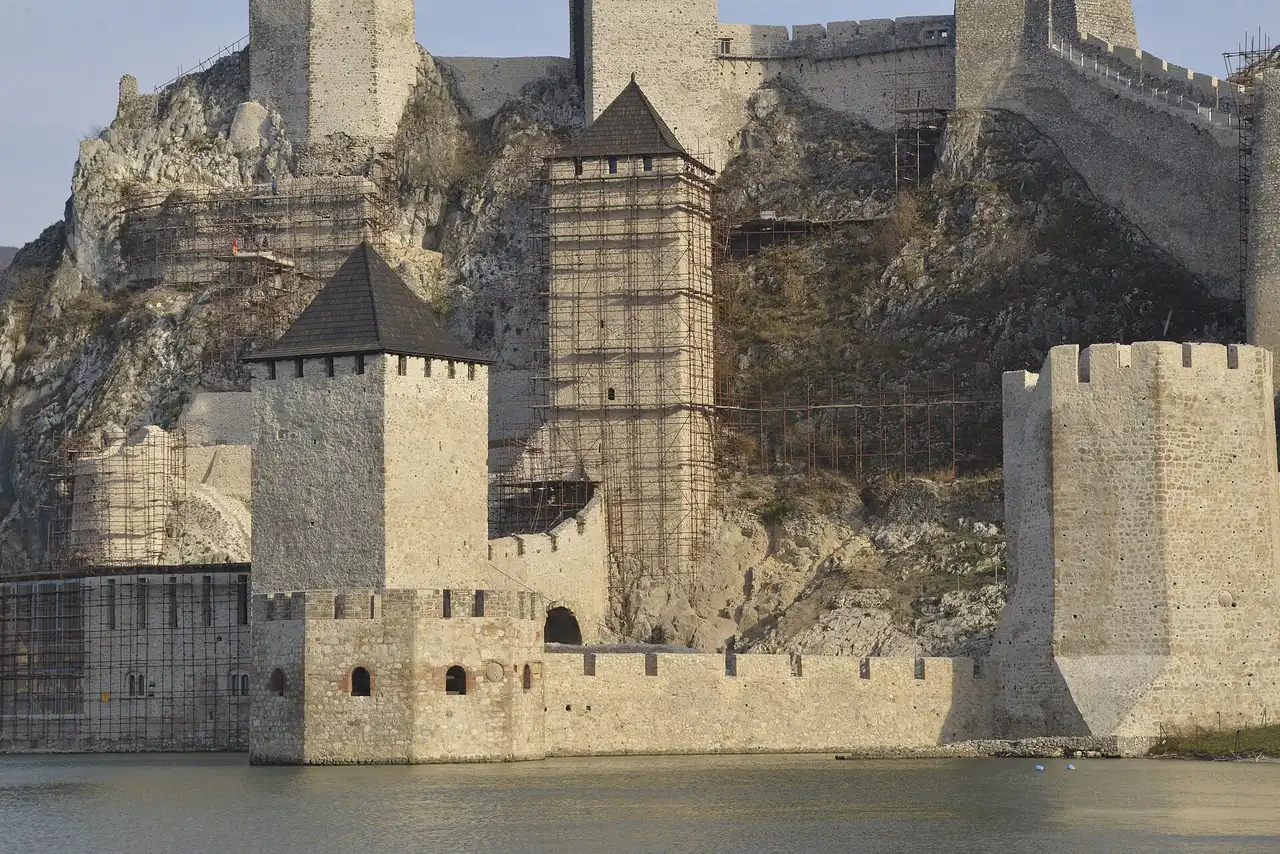
One detail tells you how neglected the site once was: for decades a public road ran straight through the fortress gates, threaded between the towers since the 1930s and slowly shaking the place apart. The restoration fixed that by blasting a 152-metre road tunnel through the hillside behind the castle - carefully, with controlled charges so as not to crack the walls - which opened in July 2017. So today you walk the fortress without traffic through its middle, which wasn’t true before about 2018.
Golubac tickets, hours and the tower “zones”
Golubac is one of the more thoughtfully run sights in Serbia, and it uses an unusual zone system: the deeper and higher into the fortress you want to go, the more you pay and the more supervision it requires. Prices are in Serbian dinars (RSD) and every ticket, helpfully, includes parking and the visitor centre. These are the official rates and opening days, checked against the fortress website in July 2026:
- Zone I (Green) - the Palace and Towers 9, 8 and 5, open to everyone including children with an adult: 950 RSD for adults (500 seniors, 350 students, 250 for children 7-18, free under 7). Runs Tuesday to Sunday, all the hours the fortress is open.
- Zone II (Blue) - adds Tower 4; adults only, up to 20 at a time, no guide: 1,600 RSD. Friday to Sunday only, 10:00-13:00.
- Zone III (Red) - Tower 7 with a dedicated guide: currently closed, with no reopening date announced.
- Zone IV (Black) - the full climb, adding the Hat Tower and Tower 3, with a guide and safety gear, two people at a time: 2,500 RSD. Friday to Sunday only, 10:00-13:00.
That upper-zone timetable is the thing to plan around, because it catches people out. Arrive on a Tuesday or a Thursday and the green zone is all you can buy, whatever the four-zone price list implies - the towers above it aren’t staffed. If the exposed climbs are the reason you’re making the drive, come on a Friday, Saturday or Sunday morning and be there at opening: the window shuts at 13:00 and the black zone takes two visitors at a time, so it’s worth calling ahead. For everyone else the green zone genuinely is plenty - the palace, the main towers and the views, no booking and no hard hat.
On timing: the fortress is closed on Mondays year-round, and its hours shift with the season - 10:00-14:00 in deep winter, 10:00-17:00 in May, June and September, stretching to 10:00-18:00 in July and August. Ticket sales stop 45 minutes before closing for the green zone and a full hour before for the upper ones, so the cut-off comes earlier than the posted hours suggest. Bring cash in dinars, as with most sights out here.
Lepenski Vir: one of the oldest settlements in Europe
Deeper into the gorge, on the Serbian bank near Donji Milanovac, is something genuinely astonishing and easy to underrate from a photo: Lepenski Vir, one of the oldest planned settlements in Europe. People lived here on a curve of the Danube for thousands of years - the site spans roughly 9500 to 5500 BC, with its remarkable stone-built phase around 6300-6000 BC - building the same distinctive trapezoidal houses on the same spot, generation after generation, before farming had even reached this part of the continent.
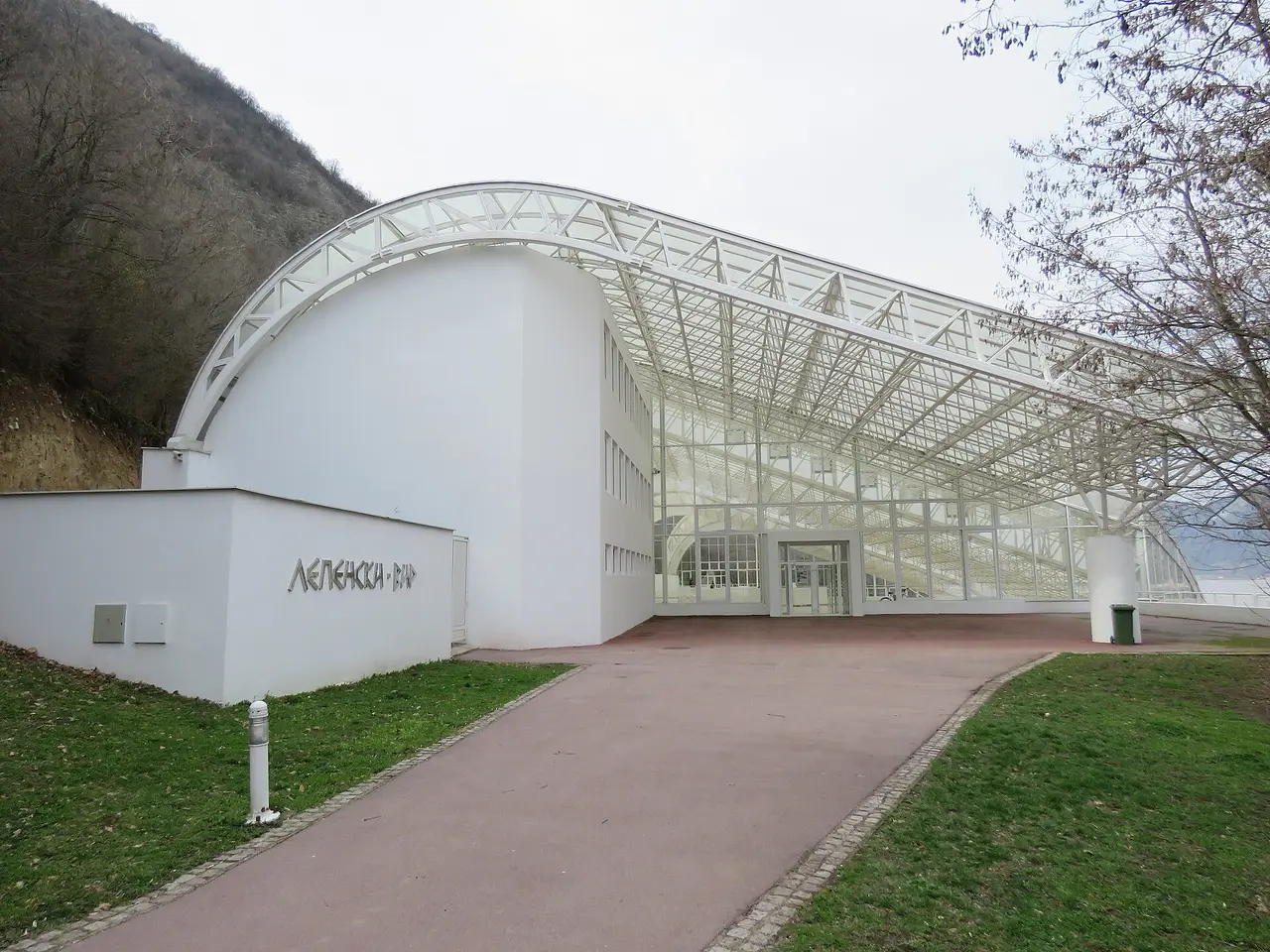
What makes it unforgettable is the sculpture. The people of Lepenski Vir carved boulders of Danube sandstone into haunting fish-and-human faces - round-eyed, downturned-mouthed figures among the earliest monumental sculpture anywhere, unlike anything else from their era. When the Iron Gate dam flooded the gorge in the early 1970s, the whole site was lifted nearly thirty metres uphill to save it, and today the excavated dwellings sit under a glass-roofed museum hall (opened in 2011) that lets you walk above them. It rewards a little reading beforehand - come knowing what you’re looking at, and it’s one of the most moving places on the Danube.
Lepenski Vir isn’t Serbia’s only prehistoric name on the Danube, just its most dramatic. Closer to the capital, Vinca is a separate, later Neolithic culture with a small museum of its own, right at Belgrade’s edge rather than deep in the gorge - see our Vinca archaeological site guide for the prehistory without committing a full day to the drive out here.
Tabula Traiana and the Decebalus rock: Rome and Dacia face off
Further downstream, where the gorge tightens into its most dramatic section, the river becomes a history lesson written on the cliffs - and this is the part you can only really see from the water.
On the Serbian side is the Tabula Traiana, a Roman stone plaque set into the rock to mark the completion of the military road the Emperor Trajan drove along the Danube in the early 2nd century AD - the road that carried the legions to their final conquest of Dacia in 106. When the dam raised the water level, the plaque was cut out and lifted about twenty metres to keep it above the new shoreline, which is why it now sits high on the cliff, best viewed from a passing boat.
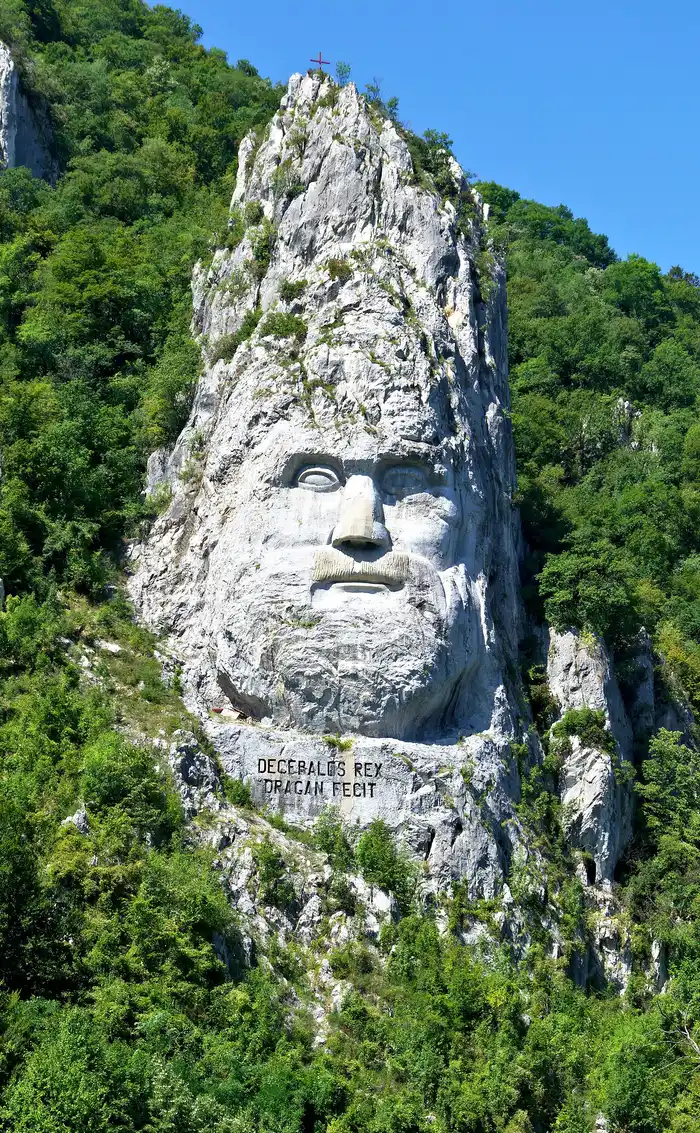
Almost directly opposite, on the Romanian bank, glares the answer to Rome: the rock sculpture of Decebalus, the last king of Dacia, who fought Trajan and lost. It’s a colossal face carved straight into the cliff - about 55 metres tall, which makes it the tallest rock relief in Europe - and it’s far more recent than it looks, cut by twelve sculptors between 1994 and 2004 at the expense of a Romanian businessman. Roman plaque and Dacian king staring each other down across the narrowest water in the gorge, nineteen centuries after the war they commemorate: it’s the single most memorable few minutes of any Iron Gate cruise.
Taking a boat into the Kazan
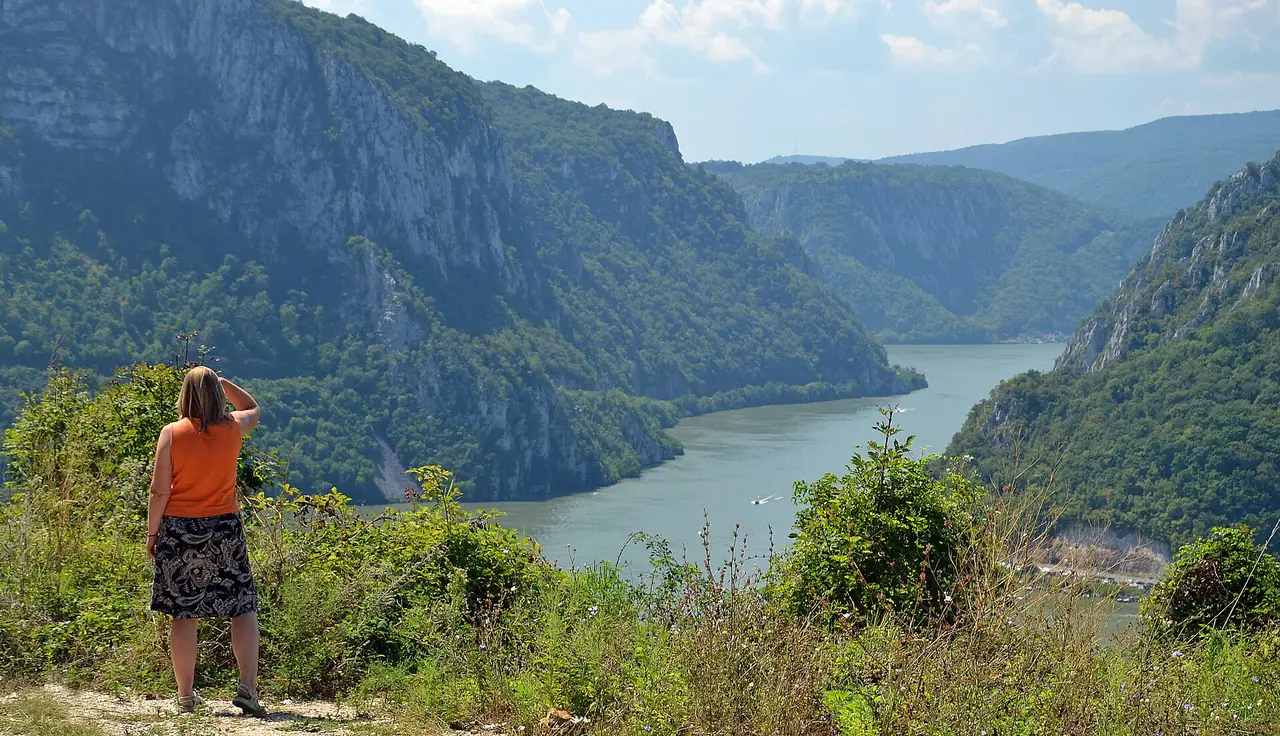
To see the Tabula Traiana, Decebalus and the sheer drama of the narrows, you need to get on the Danube - and the classic stretch is the Kazan, meaning “the Cauldron,” where the gorge closes to its tightest, squeezing to roughly 150 metres wide. On depth the sources part company: Wikipedia gives up to 53 metres in the Kazan, while boat operators advertise 90 metres - the bigger number is theirs, not a survey figure. For operators, prices and day-tour packages, see Danube river cruises in Serbia. Standing at the bottom of cliffs that rise several hundred metres straight out of the water is a genuinely different scale of landscape from anything else in Serbia.
Small tour boats run this section in the warmer months. One established operator, for example, runs a 75-minute cruise from the village of Tekija (upstream of Kladovo, deep in the gorge) for around 1,700 RSD a person, with a minimum group size - taking in the Great and Small Kazan, the riverside Mraconia Monastery, the Tabula Traiana and the Decebalus carving. Other boats leave from Donji Milanovac and elsewhere, and there’s no single fixed fare across operators, so it’s worth arranging your ride locally, through your accommodation, or as part of a tour that folds the boat trip in with the driving.
If you’d rather not stitch the driving, parking and boat booking together yourself, an organised day trip from Belgrade handles the lot - and given how spread out the stops are along the river, it’s a genuinely efficient way to see the highlights in one go.
Đerdap National Park and when to come
All of this sits inside Đerdap National Park, Serbia’s largest, protected since 1974; in 2020 the wider area was recognised as a UNESCO Global Geopark. Beyond the headline sights it’s deep beech and oak forest, karst caves and some of the richest wildlife in the country - one of the last corners of Serbia with a real population of large mammals - so even the drive between stops, hugging the river under the cliffs, is part of the experience.
The season to come is broadly April to October, and the boats run in the warmer half of that. Late spring and early autumn (May-June, September) are the sweet spot: the fortress keeps longer hours, the weather is kind, and the gorge is at its greenest without the full heat of a Serbian July. Summer works fine - Golubac stays open until 18:00 and the river is at its most inviting - just start early to dodge the midday sun on the exposed ramparts. In winter the fortress cuts back to short hours and the boats stop, so the cold months are more about the empty, dramatic landscape than about ticking off every sight.
Golubac and the Iron Gate are the obvious big day out to the east of the capital - to see how it stacks up against the other options, from Novi Sad to Smederevo, see our roundup of the best day trips from Belgrade; for the city end of the trip, see our guide to things to do in Belgrade; for another great Serbian fortress, right in the heart of the capital at the meeting of two rivers, read our Kalemegdan Fortress guide; and browse more of the country’s castles and landscapes in the attractions section. The gorge is also the closing act of our 10-day Serbia road trip, which loops the whole country by car. If the Danube leaves you hungry for more of the empty east, the Timok Valley wine and Rome loop heads inland from here - away from the river to the Roman palace of Felix Romuliana and the old wine cellars of Rajac - as a two-day overnight rather than a day trip. An hour south of the gorge, the eastern Serbia wonders loop gathers the fortified Manasija monastery, Resava Cave and the turquoise Krupaj spring into another easy inland drive. Whichever way you do it - your own car or someone else’s minibus - the Danube out here is Serbia at its most cinematic.
Photos
On the map
The map loads on click - to keep the page lightweight.
The map didn’t load. Check your connection and refresh the page.
Distance ≈130 km · 1h 45m-2 h by car
- Belgrade ≈130 km · 1h 45m-2 h by car East on the Danube road via Požarevac and Veliko Gradište - a long but doable day trip, better with an overnight if you go deep into the gorge.
Read also

What to see · 10 min read
Fruska Gora Monasteries: Which to Visit
Verified · September 3, 2026Sixteen preserved Orthodox monasteries on Fruska Gora: Krusedol, Novo Hopovo, Grgeteg and Vrdnik, plus dress code and a day route from Novi Sad.

What to see · 9 min read
Viminacium: Rome and Mammoths near Belgrade
Verified · September 3, 2026Roman Viminacium near Kostolac: adult tickets 1,050 RSD, hours by season, last tour two hours before close, and why the mammoth park is shut.

What to see · 12 min read
Vinca: The Neolithic Site on Belgrade's Doorstep
Verified · August 29, 2026Vinca's Belo Brdo site is 14 km downstream from Belgrade (16 km by road): 2026 hours, tickets, what the small museum shows, and how to get there.

What to see · 10 min read
Skull Tower of Niš: Story, Tickets, Visiting Tips
Verified · August 25, 2026Ćele Kula in Niš: 1809 Battle of Čegar, chapel hours, 300 RSD tickets and how to visit respectfully from the centre or INI airport.