
Palic Lake: Vojvodina's Lakeside Retreat
Palic Lake by Subotica: the 1912 Art Nouveau resort, the wine road, Summer3p on 24-26 July 2026, and why bathing in the lake is advised against.
Palic is a lake resort 8 km east of Subotica, and what you come for is the architecture, the park and the wine rather than the water. The Public Health Institute in Subotica rates the lake class V and advises against swimming in it, so plan a day of promenade, terraces, cellars and a zoo, and you’ll get one of the best half-days in Vojvodina. Plan a beach day and you will be disappointed by lunchtime.
The whole resort went up in one burst. In the 1900s Subotica was rich, Hungarian and ambitious, and it hired Marcell Komor and Dezso Jakab, the Budapest pair behind the town’s City Hall, to turn a muddy medicinal lake into a proper spa. Between 1909 and 1912 they built a water tower, a grand terrace, a music pavilion, a bathing lido on piles and a memorial fountain, all in Hungarian Secession, and laid a park around them. Everything worth seeing at Palic today is one of those buildings or grew up next to them.
The 1912 ensemble, building by building
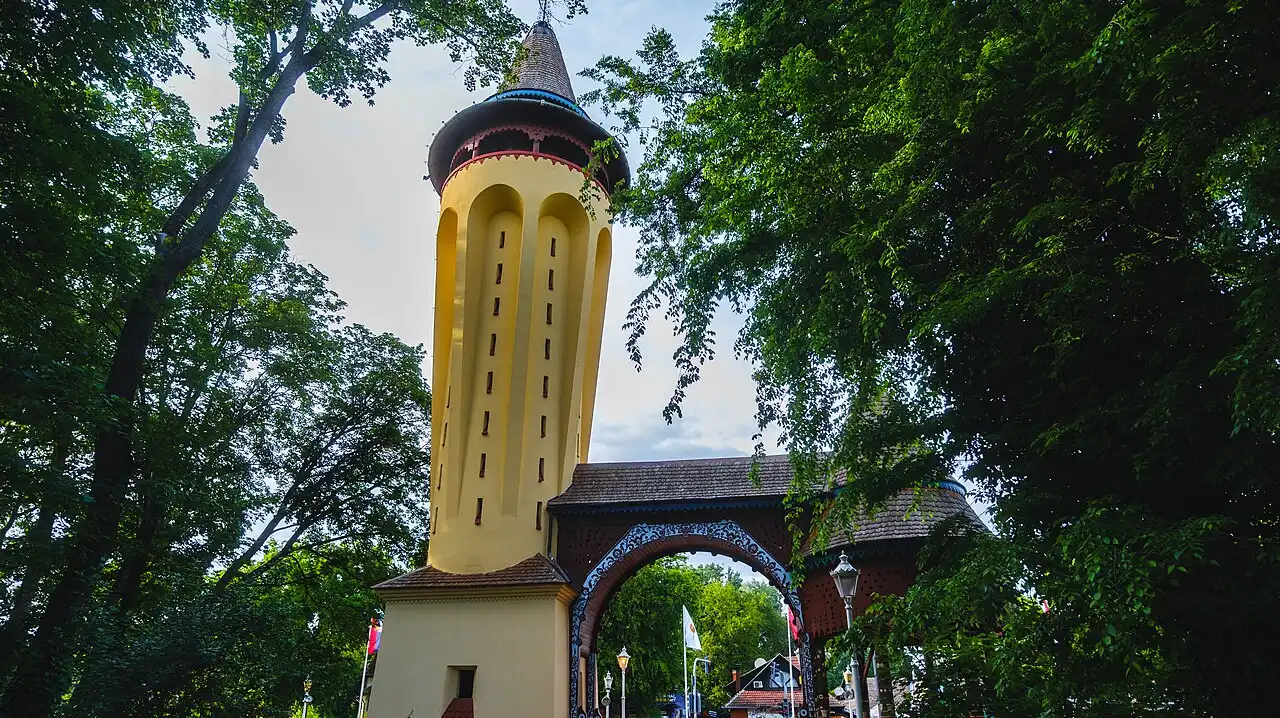
The Water Tower is the gate to the resort and the thing you photograph first: a fat yellow tower of 1912, a cultural monument since 1983, with a low timber archway at its foot. That archway isn’t decoration. It was the tram halt. An electric tram ran the nine kilometres from Subotica to the lake from 7 September 1897 until 2 April 1974, open-topped cars in summer, and its columns were cracked and insect-eaten by the time restorers reached them. The tower was restored in place from late July 2023 to spring 2024 with 21.4 million dinars of provincial money: scaffolding rather than demolition, a new shingle roof and decorative woodwork, the wooden stair swapped for a metal one clad in timber. The part worth knowing is the part that didn’t happen. It was meant to reopen as a viewpoint, and it will not: the fire inspection refused to sign that off because the inside is very narrow and unsafe to use, said Balaz Sic of the intermunicipal heritage institute in June 2024. Photograph this one from the park.
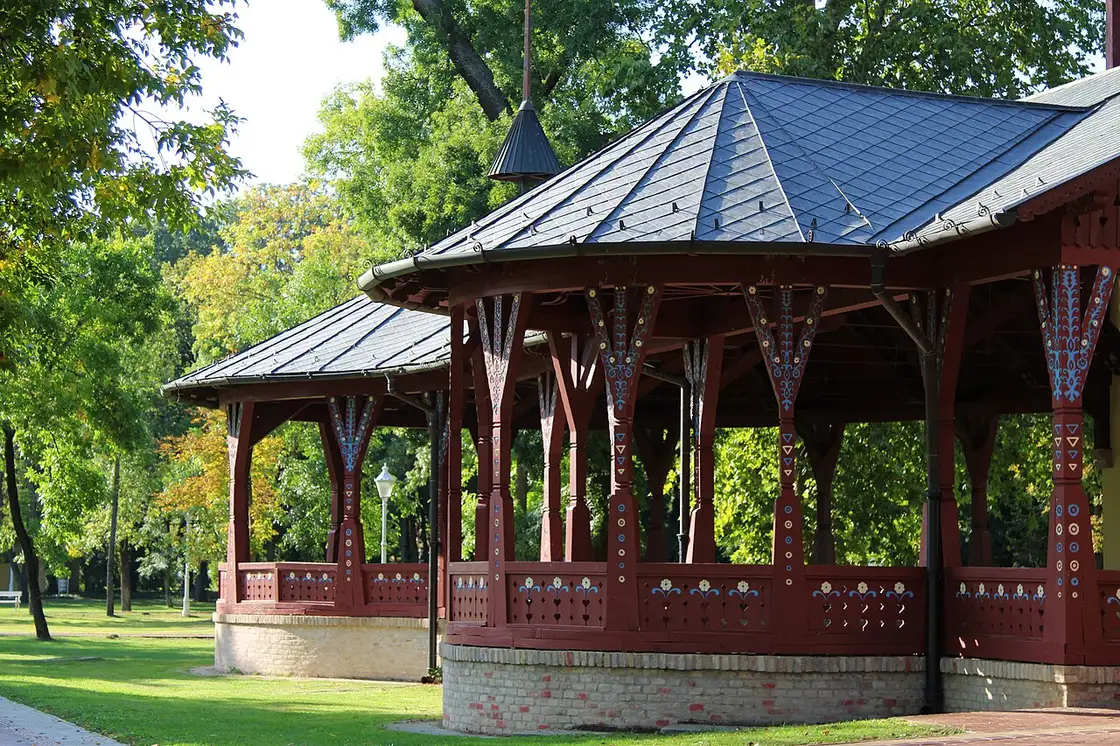
The Grand Terrace sits between the park and the shore: deep red timber, blue and white folk ornament, a long open colonnade meant for a Sunday orchestra and a thousand promenading guests. Walk through the archway under it rather than around it. The framed view down the lime avenue to the water is the single best composition at Palic, and it’s free.
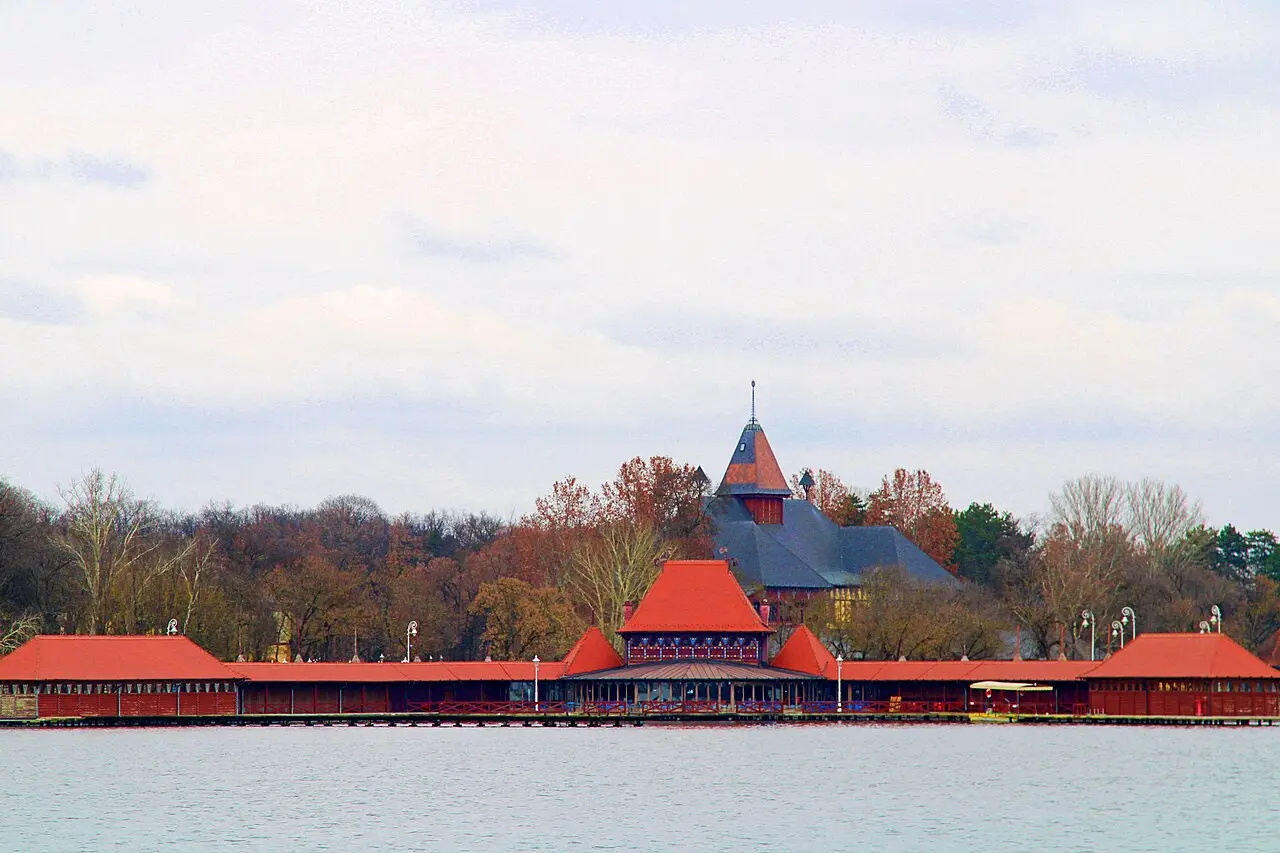
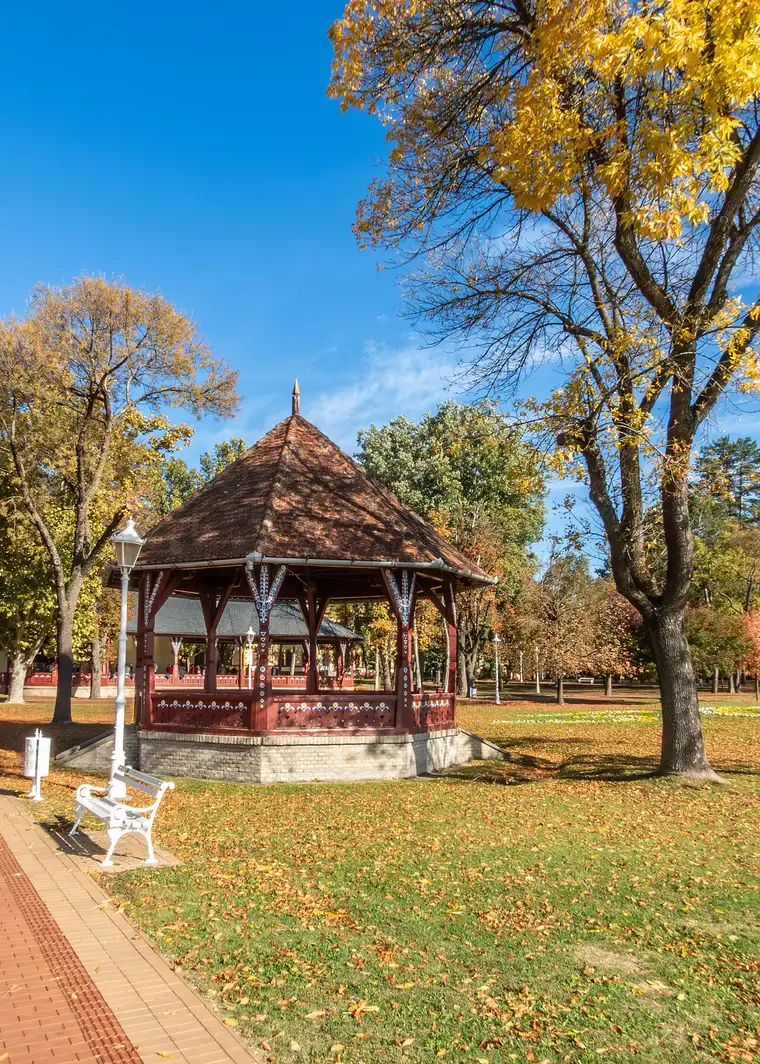
The Music Pavilion stands in the park a short walk away, painted the same red, and it still gets used for concerts on summer evenings. The Women’s Lido is the strange one and my favourite: a long red bathing pavilion raised on piles over the lake, built so that women could change and swim out of sight of the men on the shore. Park Palic dates it to 1909. It works as a cafe-bar now, and the terrace sits roughly half a metre above the water, which is as close to swimming as anyone at Palic should currently get.
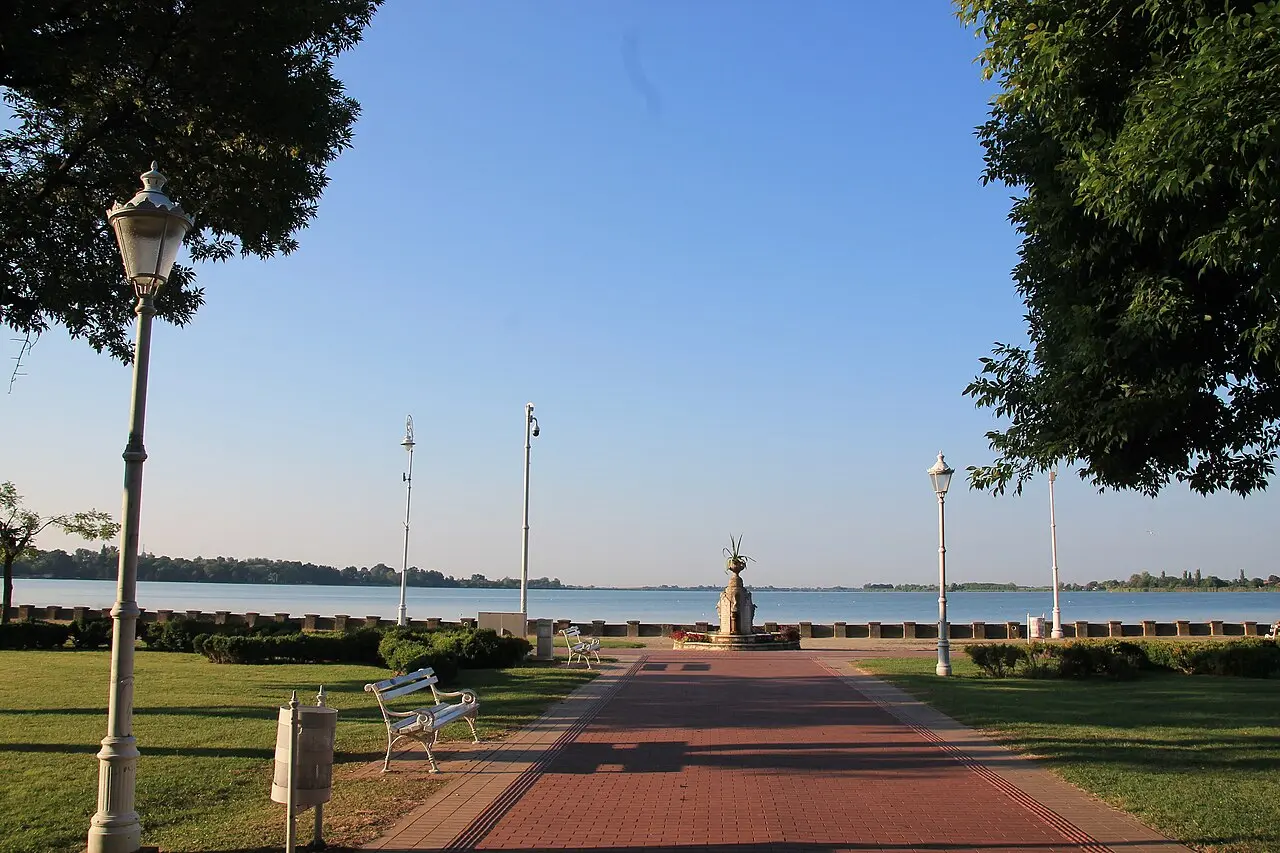
One thing to know before you arrive in the summer of 2026: the Memorial Fountain is not there. The fountain of 1912, built to mark the completion of the Palic buildings and of Subotica City Hall, was dismantled and taken away for its first full restoration since 1995. As of 21 July 2026 the stone was back at the lake and being reassembled, with the work aimed at 12 August 2026. Turn up before then and the axis at the end of the promenade is a fenced building site. If you turn up after, you’ll see something almost nobody photographed in the last thirty years: the bronze figures cleaned back to their proper colour.
The water, and why the advice is to stay out
Palic is shallow and salty. The whole lake is 4.6 square kilometres, of which the tourist sector is 3.8; English pages tend to quote the smaller figure as if it were the lot. Length depends who you ask, 8 km on the English Wikipedia against about 5.5 km on Subotica’s own tourist board, so call it six to eight. The rest is agreed: a kilometre or so wide, under two metres deep on average, 3.5 m at the deepest, about 17 km of shore. Shallow, warm and fed by a city means algae, and the lake has a long history of it. In 1970 eutrophication peaked and almost everything in the lake died; in 1971 it was drained, dredged, filtered, and by 1976 refilled. It is now managed as four sectors, the fourth the tourist one.
That fix didn’t hold. The Public Health Institute in Subotica puts the water in the fifth class, and water of the fourth and fifth classes isn’t recommended for bathing or recreation. Blue-green algae make up around 80 per cent of the phytoplankton. Dr Karolina Berenji, who heads the institute’s hygiene centre, said in July 2026 that the summer pH reaches nine or more, high enough on its own to irritate skin, eyes and mucous membranes, and that the green scum along the shore is dead algae, at its worst in August and September. In other words the lake looks least appealing exactly when most visitors come.
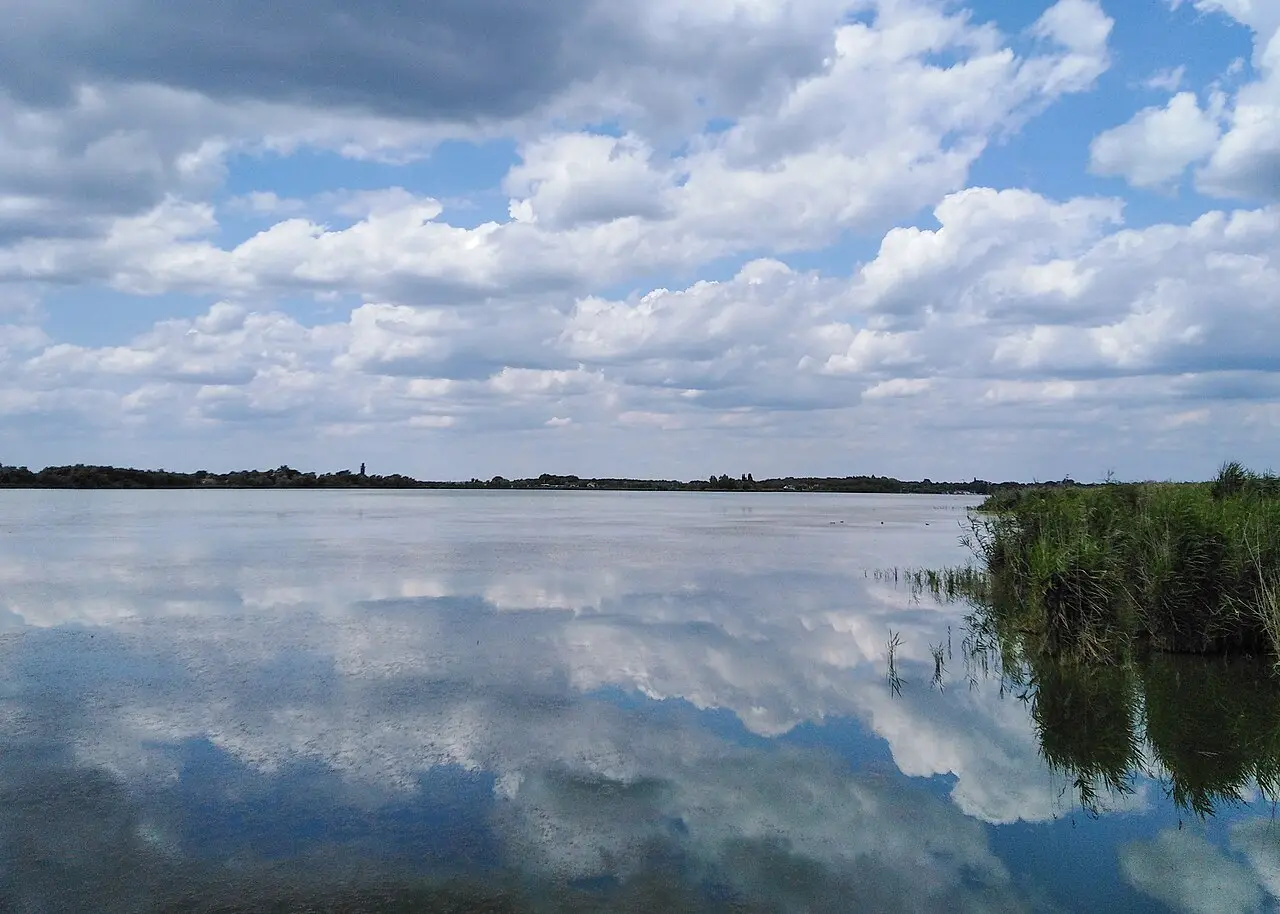
None of that spoils the visit if you know in advance. Rowing, walking, cycling and terrace-sitting are unaffected, and the birdlife on the reedy stretches is genuinely good.
If the plain hits 35 degrees and someone has been promised water, you need not drive back to Subotica’s pools. There is an aqua park at Palic itself, on Novosadski put, thermal pools indoors and out, open 10:00 to 20:00. Its own list asks 900 RSD an adult and 600 a child aged 2 to 12 for the day, 2,500 for two adults and two children, or 600 / 400 after 16:00. That is the swim at Palic. The lake is the view.
Summer3p, 24 to 26 July 2026
The 24th Summer3p runs from Friday 24 to Sunday 26 July 2026 at the Druga kasarna, the former Petar Drapsin military complex on Segedinski put between Subotica and the lake. Vojvodina’s electronic weekend: DJs after dark, workshops and open-air programming by day. On the gate it’s 899 dinars each for Friday and Saturday; in advance, over a counter in Subotica and in limited numbers, the two days go as one ticket for 1,200 against 1,798 at the door. Sunday is Family Day with free entry, which is the best-value thing happening at the lake all summer if you’ve children with you.
Beds in Subotica and at the lake go early that weekend, so book where you sleep first. Getting back after a late set is less hopeless than it looks: the tariff carries night departures between 22:35 and 03:45 on the Lifka to Vikend Naselje to Palic line at 120 dinars, cash to the driver, passes and concessions not valid. How they behave on a festival Saturday is nowhere published, so read the board at the stop and keep a taxi number in reserve. The rest of Serbia’s festival year, from Guca to EXIT, is in our guide to Serbian music festivals.
The other date to know is the Palic European Film Festival, which runs in mid-July; the 33rd edition played from 18 to 22 July 2026. Screenings spread across Palic and Subotica, and the main competition plays at the Summer Stage, an open-air cinema of 1950 by the engineer Baltazar Dulic, among century-old pines in the park. Watching a European premiere outdoors under those trees is the strongest argument for timing a Vojvodina trip to mid-July.
Wine on the sand
The vineyards grow on sand left by the vanished Pannonian sea, which gives the region its “sand wine” label and its long run of Italian Riesling.
The address most people head for is Zvonko Bogdan, Kanjiski put 45 on the eastern shore, a 2008 winery built in knowing imitation of the local Art Nouveau. Its price list gives three tours: Standard 1,500 RSD with three Signature wines, Premium 1,900 RSD with four Premium wines, and Deluxe 2,300 RSD with six from the Premium and Icon lines. If you’re only doing one, take the Premium: 400 dinars over the Standard changes the class of wine rather than adding a glass, and the Deluxe is for people who already know they want the Icon bottles. Two details catch people out: tours must be booked 48 hours ahead, and the winery shuts at 16:00 from Sunday to Wednesday, 18:00 Thursday to Saturday. DiBonis is the other name on the wine road, pouring in a rustic cellar; it publishes no tasting prices, so ring ahead.
If wine is the point, the bigger cluster is two hours south on Fruska Gora, where monasteries and cellars share a hill.
The zoo, the park and the birds
Palic Zoo opened in 1949 and covers about ten hectares on the lakeshore. Set expectations by that date: a post-war municipal zoo laid out inside a collection of more than 270 species of trees and shrubs, Lebanon cedars and sequoias among them, with ponds and fountains between the enclosures. With children it is a comfortable ninety minutes and the petting corner does most of the work; without them, and especially if you’ve recently done a big modern European zoo, the arboretum is the better half of the visit. No price here: the zoo’s own site refused every request on 24 July 2026 and the aggregators contradict each other on tariff and closing time alike. Ask at the gate.
Around all of it lies Palic Nature Park, 712 hectares with a further 1,698 hectares of protection zone, running out into reedbeds and the salt-steppe flats towards Ludas. That’s where the birds are, and where the resort stops being a resort.
Getting there, and how long to give it
Several city bus lines run from Subotica to Palic; the useful stops are Zoo, Kosut Lajosa and Palic itself. The operator changed in 2025: Trans-Jug, trading as SuBus, took over on 1 March on a fifteen-year contract, ending a century of JP Subotica-trans. Fares didn’t move with it: the city sets and subsidises them. The city tariff applies as far as Palic centre: 120 dinars for a single bought on the bus, 90 in advance. The published price list still carries the old company’s name and a February 2023 date, so have small notes ready. A taxi from the centre of Subotica is short and cheap; cycling is flat and pleasant.
From Belgrade the sensible chain is the Soko fast train to Subotica, about 80 minutes for around 1,200 dinars, then the bus east. Our Belgrade to Subotica guide has the timetable detail, including which departures are actually the fast train.
Give the lake half a day on top of Subotica’s centre, or a full day if you add a winery and the zoo. Staying the night makes sense in three cases: a festival weekend, a film-festival evening, or the promenade at sunset without watching the clock for the last train. Spring and September are the kindest months, and our guide to the best time to visit Serbia explains why July on the Pannonian plain is not for everyone.
Palic works best when you stop expecting a beach resort and start reading it as what it is: a Habsburg-era spa that lost its bathers, kept its buildings and quietly grew a wine road. Browse the rest of the country’s sights in the attractions section, or pair the lake with Novi Sad for a full Vojvodina weekend.
Photos
On the map
The map loads on click - to keep the page lightweight.
The map didn’t load. Check your connection and refresh the page.
Distance
- Belgrade ≈190 km · 80 min by Soko train to Subotica, then a city bus The fast train reaches Subotica in about 80 minutes; Palic is a short bus or taxi ride further east.
- Novi Sad ≈108 km · About 1 h 15 by car Straight up the E75; the Palic exit is about five minutes from the lake.
Read also

What to see · 10 min read
Fruska Gora Monasteries: Which to Visit
Verified · September 3, 2026Sixteen preserved Orthodox monasteries on Fruska Gora: Krusedol, Novo Hopovo, Grgeteg and Vrdnik, plus dress code and a day route from Novi Sad.

What to see · 9 min read
Viminacium: Rome and Mammoths near Belgrade
Verified · September 3, 2026Roman Viminacium near Kostolac: adult tickets 1,050 RSD, hours by season, last tour two hours before close, and why the mammoth park is shut.

What to see · 12 min read
Vinca: The Neolithic Site on Belgrade's Doorstep
Verified · August 29, 2026Vinca's Belo Brdo site is 14 km downstream from Belgrade (16 km by road): 2026 hours, tickets, what the small museum shows, and how to get there.

What to see · 10 min read
Skull Tower of Niš: Story, Tickets, Visiting Tips
Verified · August 25, 2026Ćele Kula in Niš: 1809 Battle of Čegar, chapel hours, 300 RSD tickets and how to visit respectfully from the centre or INI airport.