
Petrovaradin Fortress: Novi Sad's Gibraltar
A deep dive into Petrovaradin Fortress: the star-fort design, the 1716 battle, 16 km of underground galleries and the artists who live on the ramparts.
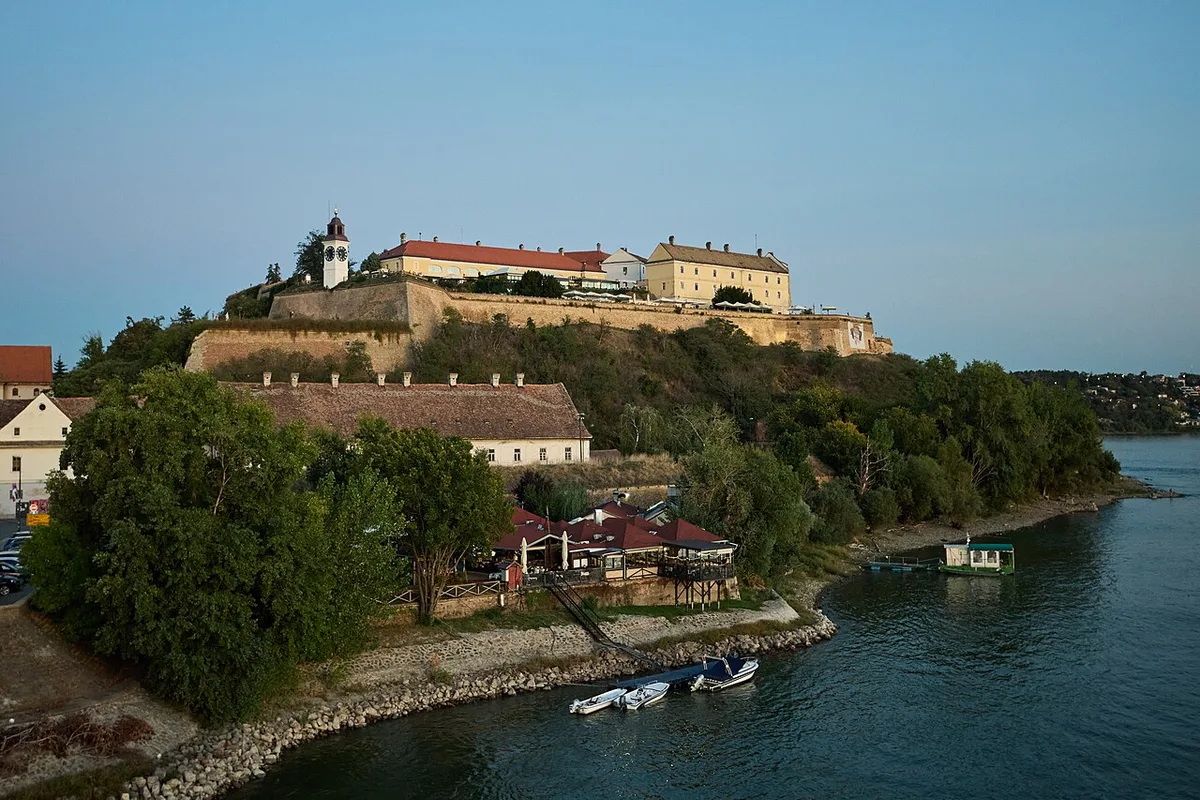
Petrovaradin is the giant that most people photograph and half of them misunderstand. Stand in the old town of Novi Sad and look across the Danube, and the long yellow barracks and the white clock tower on the rock read like a pretty skyline. They’re actually the visible tip of an eighteenth-century war machine: a bastioned Austrian fortress so large, so cleverly angled and so honeycombed with tunnels that it never fell to an attacker, and that soldiers of the day rated the equal of Gibraltar. Our Novi Sad travel guide covers it as one stop on a city day out. This is the closer look for anyone who wants to understand the thing they’re walking on: why it was built the way it was, the battle that made its name, the sixteen kilometres of galleries under your feet, and the artists who now keep studios in its casemates.
Why is it called the “Gibraltar on the Danube”?
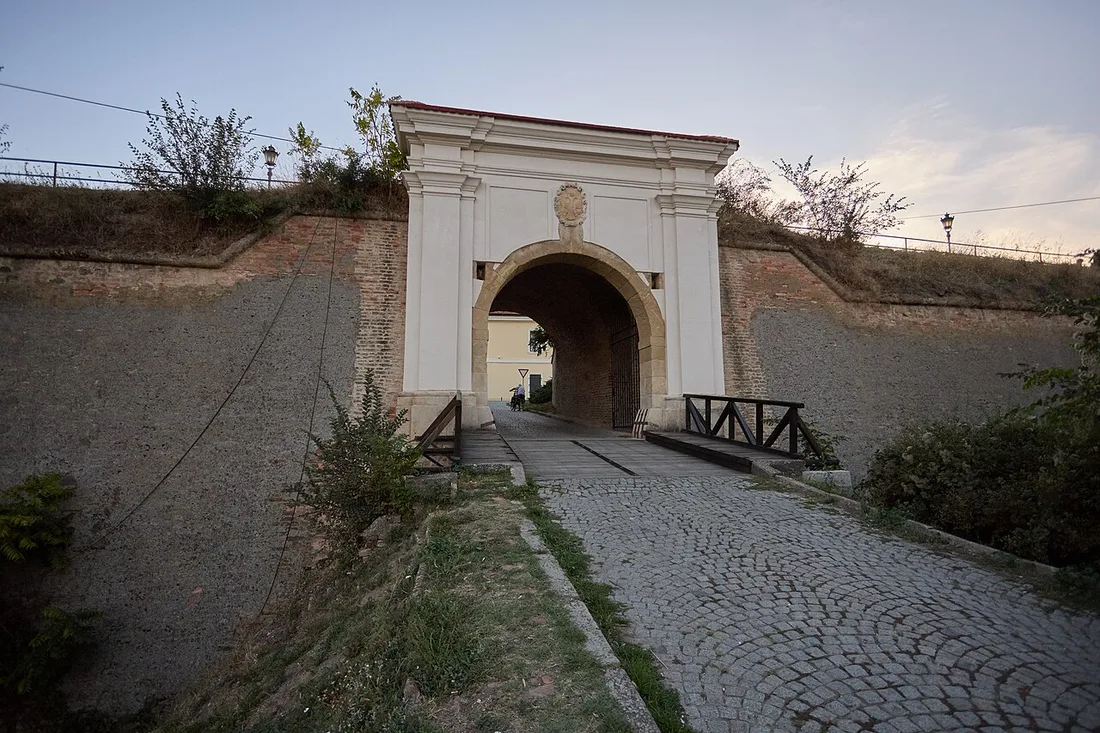
The nickname isn’t tourist-board hype; it’s a military judgement. Petrovaradin guards the point where the Danube swings past a rocky bluff on the river’s right bank, the last natural chokepoint before the plains open toward Hungary. Whoever held this rock controlled the river road, so the Habsburgs poured a fortune into making it unassailable. What they built is a textbook example of the bastioned star fort, the system of geometry-driven defence associated with the French marshal Sébastien Le Prestre de Vauban: instead of tall medieval walls that a cannon could batter, you get low, thick earthworks faced in brick, thrown out into arrow-headed bastions so that every stretch of wall is covered by crossfire from the next. Add a ring of outworks, ravelins and a deep dry moat, and an attacker has no blind spot to hide in and no flat wall to smash.
Petrovaradin wasn’t designed by Vauban himself. The plans came from Habsburg military engineers, chiefly the Italian polymath Count Luigi Ferdinando Marsigli and Colonel Count Mathias Kaisersfeld, with the field works run by Colonel Michael Wamberg. But it’s Vauban’s school of fortification, executed on a huge scale, and that’s the accurate way to read the “Gibraltar” tag: not a castle, but a science experiment in staying alive under artillery fire.
The numbers, and which ones to trust
Work on the modern fortress began on 18 October 1692, when Charles Eugène de Croÿ laid the cornerstone, a year after the Austrians broke the Ottoman hold on the region at the battle of Slankamen. Building dragged on, with long interruptions, until around 1780, which is where you get the round claim that it took 88 years to finish. Treat that as a headline rather than a stopwatch reading, because the fortress was in use and being altered the whole time. When the works were done it sprawled over 112 hectares, which is what makes the place feel less like a castle and more like a small fortified town in three tiers: the Upper Fortress on the crown of the rock, the Lower Fortress and the suburb (Podgrađe) below, and a chain of hornworks reaching back inland.
You’ll see some eye-watering figures quoted for its firepower: often around a hundred gates and gun-galleries, some twelve thousand loopholes and positions for four hundred cannon. Those come from the local tourism sources, and they give a fair sense of the scale, but the counts vary depending on what you tally, so treat them as “on the order of” figures, not exact counts. What’s not in doubt is the effect. A garrison here could pour fire from the walls, from the outworks and from inside the hill itself.
The 1716 battle that sealed its reputation
A fortress earns its name in one afternoon, and Petrovaradin’s came on 5 August 1716. An Ottoman army marched up from Belgrade to besiege it, led by the Grand Vizier Silahdar Damat Ali Pasha. Facing them was one of the great commanders of the age, Prince Eugene of Savoy, who chose not to sit behind the walls and wait. He sortied out of the fortress and attacked. The fighting was short and brutal, a matter of hours, and it ended in a decisive Habsburg victory: the Ottoman camp was overrun, and the Grand Vizier himself, charging at the head of his bodyguard, was killed on the field. Prince Eugene’s men carried off well over a hundred captured cannon and scores of banners.
The battle mattered far beyond one day. It broke the last serious Ottoman push into this stretch of the Danube, opened the road to the conquest of Belgrade the following year, and confirmed Petrovaradin as the anchor of the Habsburg military frontier. After 1716 the fortress was never taken by storm. That record, as much as the engineering, is why the “Gibraltar” comparison stuck.
Sixteen kilometres of tunnels under your feet
The most extraordinary part of the fortress is the part almost nobody sees, and it’s the reason Petrovaradin is far more than a viewpoint. The Austrians didn’t just wall the hill; they hollowed it out. Beneath the ramparts runs a four-storey system of underground military galleries - mine tunnels, listening posts and communication passages - reckoned at around 16 kilometres in total length, largely completed by the 1770s. The logic was diabolical and clever. If an enemy managed to dig his own mines toward the walls, sentries in the listening galleries could hear the scraping, and the defenders would pack a counter-mine with gunpowder and blow the attackers up before they ever reached the surface. In its day this labyrinth was reputedly the second-largest of its kind in the world, after the fortress of Antwerp.
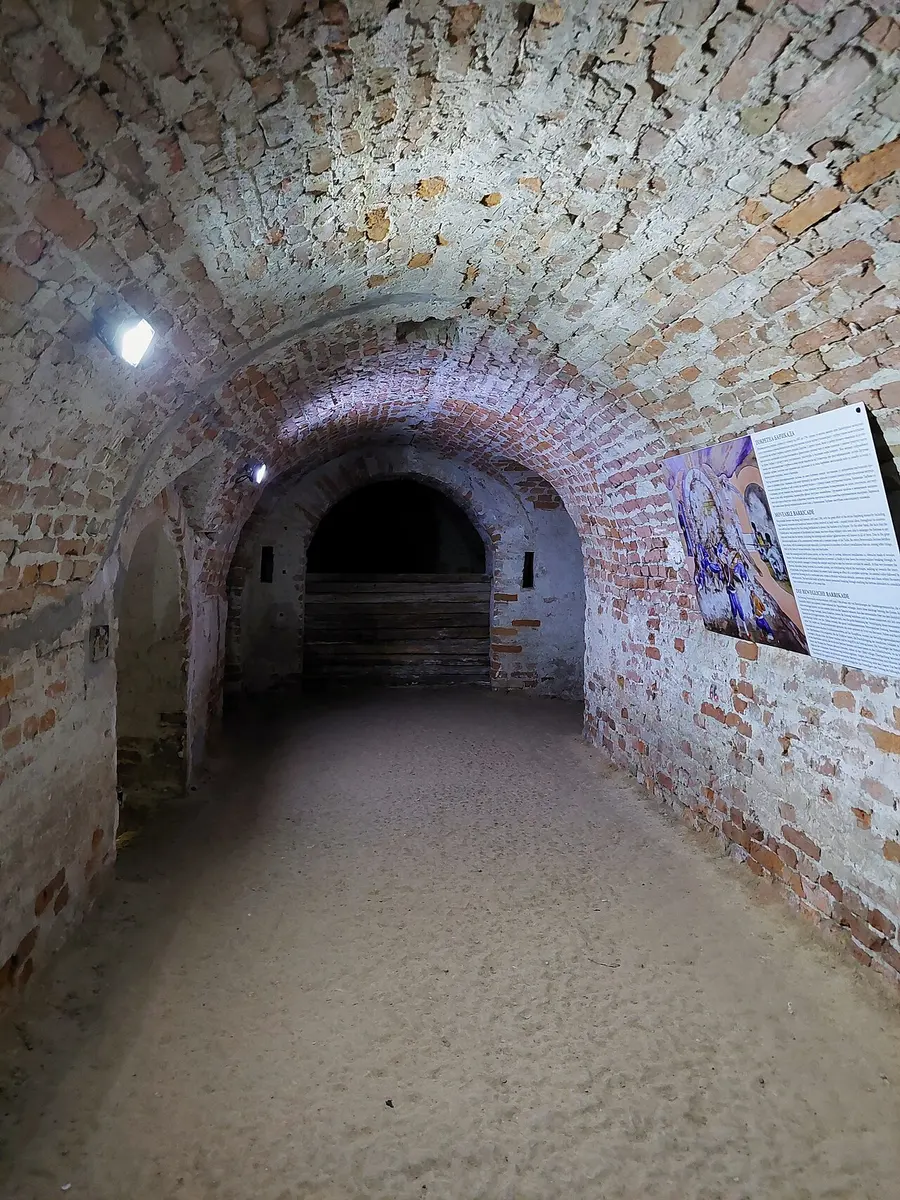
Only a short section is open to visitors, roughly 900 metres, and this is the single most important practical thing to know about the fortress: you can’t go down there on your own. The galleries are pitch dark, unmarked and easy to get lost in, so access is by guided tour only, run by the City Museum of Novi Sad from the Arsenal building on the plateau. Ask at the museum for the next departure; tours run more often in summer and thin out off-season. An hour underground, following a guide’s torch past the gun chambers and hearing how the counter-mining worked, is what turns a walk on the ramparts into an understanding of the place. If your Serbia trip only has room for one fortress interior, this is a strong candidate for it.
The upside-down clock
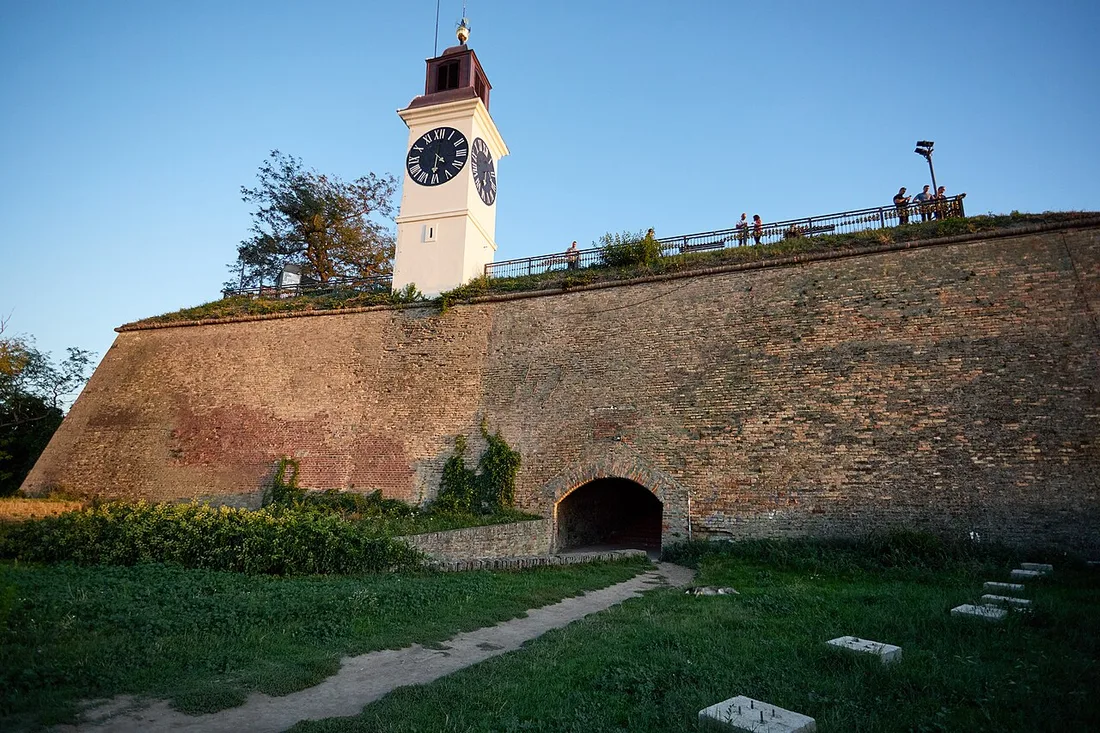
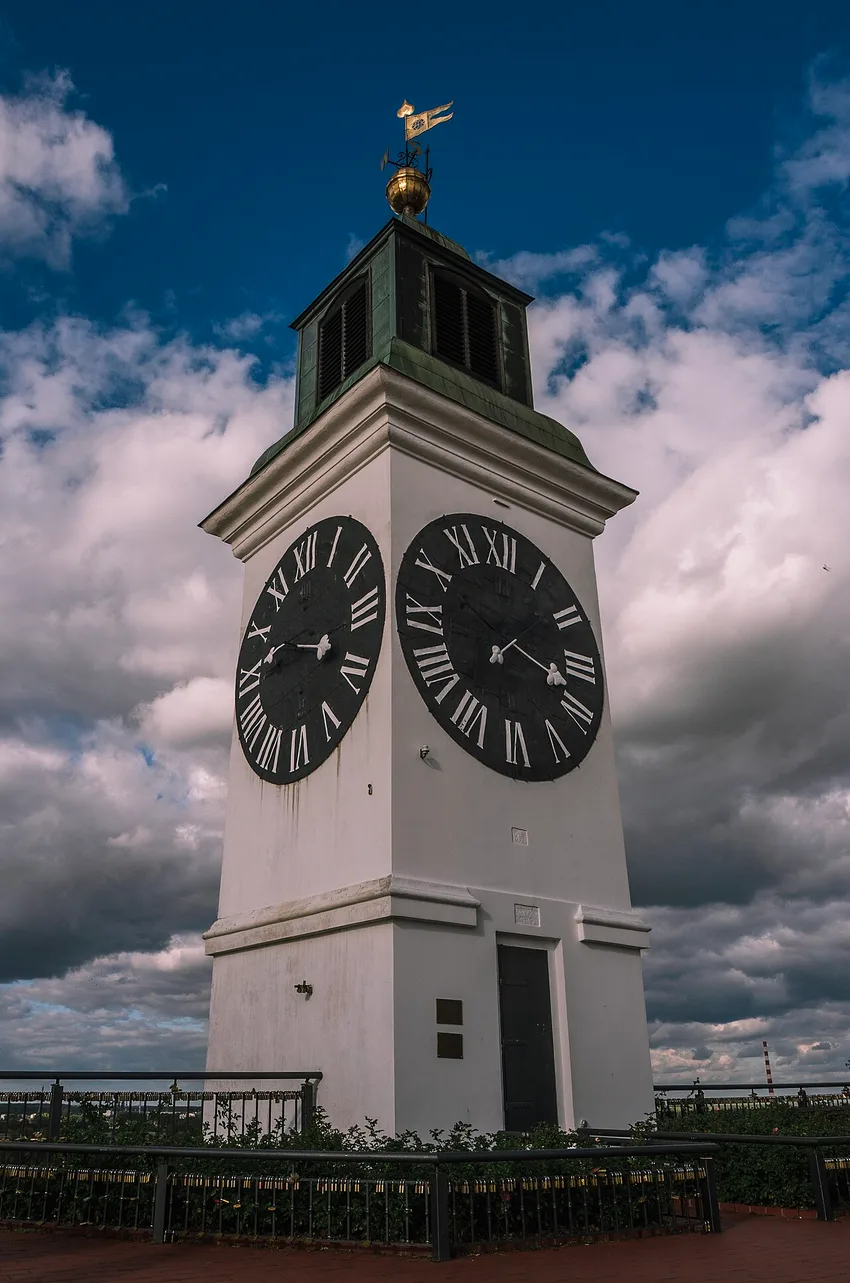
The white clock tower on the upper terrace is the fortress’s signature, and it hides a good joke: the hands are swapped, with the large hand showing the hour and the small one the minutes, so that boatmen down on the Danube could read the time from a distance. Locals call it the “drunken clock” because the hand-wound mechanism runs slow in the cold and fast in the heat. It’s a lovely detail. The full story is in the Novi Sad guide; here, just stand under it, work out the time, and enjoy the double-take.
An artists’ colony on the ramparts
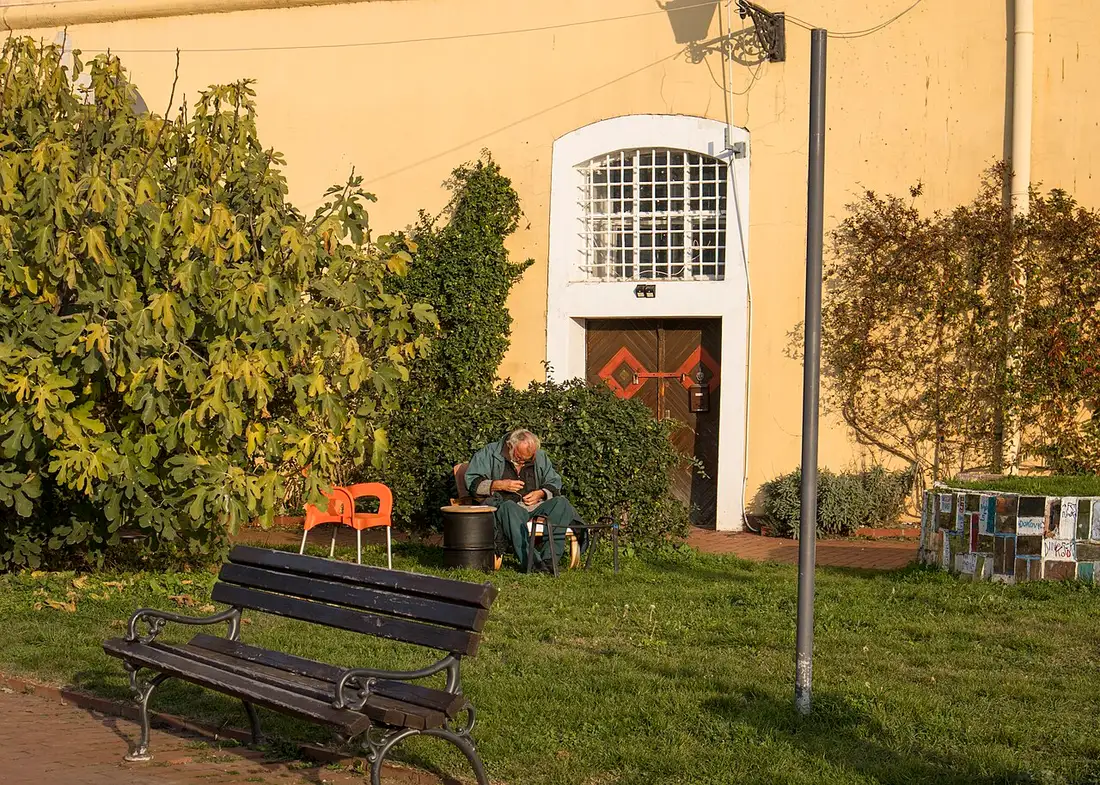
What do you do with a war machine once the wars stop? Petrovaradin’s answer is the most charming thing about it today. The old casemates and barracks along the walls have been given over to painters, sculptors and craftspeople, and the fortress now holds over a hundred art studios. The tradition goes back decades: the famous Atelier 61 tapestry workshop, which weaves large-scale artistic tapestries, was founded here in 1961, on the bastion named for Empress Maria Theresa, and a “Fine Arts Circle” of resident artists grew up alongside it. Wander the lanes of the upper town on a quiet weekday and you’ll pass open doors, drying canvases and the odd artist working in the sun, which gives the ramparts a lived-in warmth you rarely feel in a fortress.
The plateau also carries the Long Barracks (Duga kasarna), which today houses a hotel, an archive and a restaurant, and the Arsenal, home to the City Museum, all inside walls that once mounted four hundred guns.
For a quarter of a century the ramparts had one more life, as a stage. The EXIT festival, born in Novi Sad in 2000, filled the fortress every summer from 2001, packing its legendary Dance Arena into the moat. That era has closed - EXIT held its final Petrovaradin edition in 2025 and has left Serbia to tour other countries - so it’s no longer something to plan a visit around, though the fortress still fills up on warm-weather weekends. The Novi Sad guide has the full EXIT story if you’re curious.
How to actually visit
Reaching the fortress could hardly be simpler, because Petrovaradin is really the far bank of Novi Sad. From the old town it’s a 10-minute walk or short ride over the Varadin Bridge, and from Belgrade the whole thing slots onto a day trip: take the fast Soko train up in 35 to 40 minutes, then cross the river (our guide to getting from Belgrade to Novi Sad lays out the train, bus and car options in full). Give yourself a couple of hours minimum, or half a day if you want the underground tour and time to poke around the studios.
On money, keep it simple. Walking the grounds is free - you can climb up, roam the ramparts and drink in the Danube view without paying a dinar. What costs is the interior: the City Museum and the underground gallery tour each charge a modest ticket, on the order of a few hundred dinars apiece, and small cash in Serbian dinars is the smoothest way to pay. Prices drift upward year to year, so take any figure you read, ours included, as a rough guide and confirm at the museum desk on the day.
Time your visit for the light. Late afternoon into early evening is the fortress at its best: the low sun warms the brick, the Danube glows, and the whole of Novi Sad lays itself out across the water. Bring flat shoes for the cobbles and ramparts, and a layer for the tunnels, which stay cool whatever the season.
Petrovaradin pairs naturally with the rest of a Vojvodina trip. Spend the morning in the old town of Novi Sad, give the afternoon to the fortress, and keep a second day for the monasteries and wine of Fruška Gora just south of the city. To sleep near the fortress or over in the old town, our guide to where to stay in Novi Sad compares the areas. And if you’re working your way out from the capital, this sits comfortably alongside the other big excursions in our guide to things to do in Belgrade. Give it a couple of hours and the underground tour, and Petrovaradin stops being a skyline and becomes one of the most complete pieces of military engineering still standing in this part of Europe.
Photos
On the map
The map loads on click - to keep the page lightweight.
The map didn’t load. Check your connection and refresh the page.
Distance
- Belgrade ≈80 km · 35-40 min on the fast Soko train to Novi Sad, then over the bridge Easiest as part of a Novi Sad day trip - fast train from Belgrade, then cross the river.
- Novi Sad ≈3 km · 10 min by car, 25-30 min on foot over Varadin Bridge The fortress sits directly across the Danube from the old town; most people walk over from Novi Sad or take a short bus/taxi hop.
Read also

What to see · 10 min read
Fruska Gora Monasteries: Which to Visit
Verified · September 3, 2026Sixteen preserved Orthodox monasteries on Fruska Gora: Krusedol, Novo Hopovo, Grgeteg and Vrdnik, plus dress code and a day route from Novi Sad.

What to see · 9 min read
Viminacium: Rome and Mammoths near Belgrade
Verified · September 3, 2026Roman Viminacium near Kostolac: adult tickets 1,050 RSD, hours by season, last tour two hours before close, and why the mammoth park is shut.

What to see · 12 min read
Vinca: The Neolithic Site on Belgrade's Doorstep
Verified · August 29, 2026Vinca's Belo Brdo site is 14 km downstream from Belgrade (16 km by road): 2026 hours, tickets, what the small museum shows, and how to get there.

What to see · 10 min read
Skull Tower of Niš: Story, Tickets, Visiting Tips
Verified · August 25, 2026Ćele Kula in Niš: 1809 Battle of Čegar, chapel hours, 300 RSD tickets and how to visit respectfully from the centre or INI airport.