
Zlatibor: Serbia's Mountain Resort
Zlatibor travel guide: the Gold Gondola to Tornik, Sirogojno ethno-village, Stopića Cave, smoked ham and spas, and using it as a base for western Serbia.
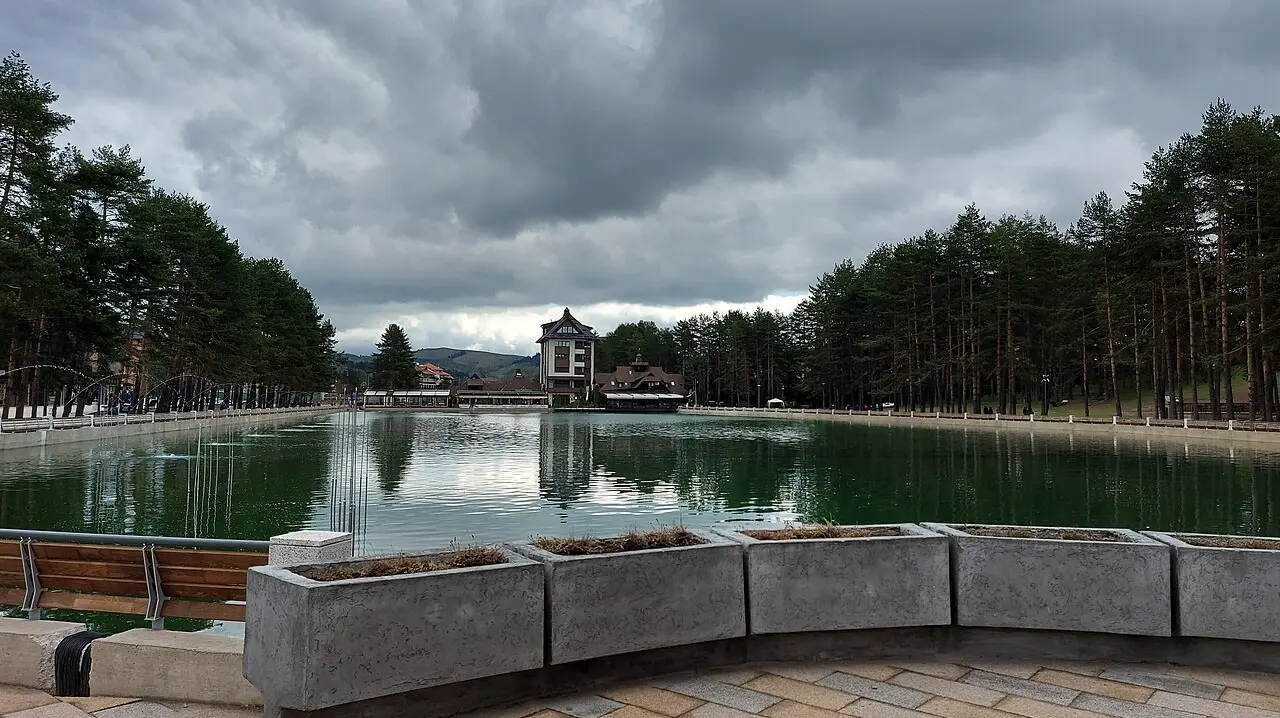
Zlatibor is Serbia’s favourite mountain, and it wears the title comfortably: a broad, sunny plateau in the west, sitting a little over 1,000 metres up, that has drawn Serbs on holiday for more than a century and now pulls well over a million visitors a year. It’s not a wild, hard-edged range. The hills are rounded and forested, the meadows gentle, the air famously clean, and the resort at its centre is a proper little town of hotels, spas, restaurants and a lake-side promenade rather than a cluster of huts. The short version: come here for easy mountain scenery, a glut of wellness hotels, some of the best cured ham and cheese in the country, and, above all, as the natural base for everything else in western Serbia.
That’s the point to hold on to. Zlatibor works brilliantly as a comfortable HQ with a full range of places to sleep and eat, from which the region’s real showpieces - the Tara National Park canyon, the Šargan Eight heritage railway and the Mokra Gora valley - are all an easy drive away. What follows is how to get the most out of both the mountain itself and everything within reach of it.
Where is Zlatibor, and how do you get there?
Zlatibor lies in the far west of Serbia, in the municipality of Čajetina, about 230 km southwest of Belgrade. The drive is one of the more painless in the country: you take the E763 motorway toward Užice for most of the way, then make a short climb up onto the plateau, and the whole thing comes in at around three to three and a half hours with a coffee stop. Unlike Tara or Mokra Gora, which are genuinely remote, Zlatibor is close enough and well-served enough that plenty of people come for a weekend.
You can reach it by bus - there are regular coaches from Belgrade to Zlatibor and Čajetina, and our guide to getting from Belgrade to Zlatibor covers the coach, the drive and the twice-daily train that exists but loses on frequency and drop-off point - but the moment you want to explore the wider region, a bus doesn’t make sense. The gondola, Sirogojno, Stopića Cave, Tara and the Šargan railway are scattered across the map, and reaching them by bus means a couple of departures a day and a lot of waiting, where a car makes each a short, easy run. If a western-Serbia road trip is even half your plan, you’ll want your own wheels here.
The resort itself clusters around a small artificial lake and the main promenade (the Kraljev Trg, “King’s Square”, area), which is where you’ll find the gondola’s lower station, the busiest restaurants and most of the shops. It’s walkable and compact; the sprawl of hotels and holiday apartments spreads out into the pines from there.
The Gold Gondola: the headline ride
The single attraction that put modern Zlatibor on the map is the Gold Gondola (Zlatiborska Gold gondola), and it’s genuinely a big deal. Running from the centre of the resort up to the Tornik ski centre, it stretches about 9 kilometres, long enough that its builder, the French firm POMA, and the operator bill it as the longest panoramic gondola lift in the world. That “world’s longest” claim gets repeated everywhere; treat it as the marketing line it is (records like this are slippery and contested), but there’s no arguing it’s an exceptionally long, exceptionally scenic ride.
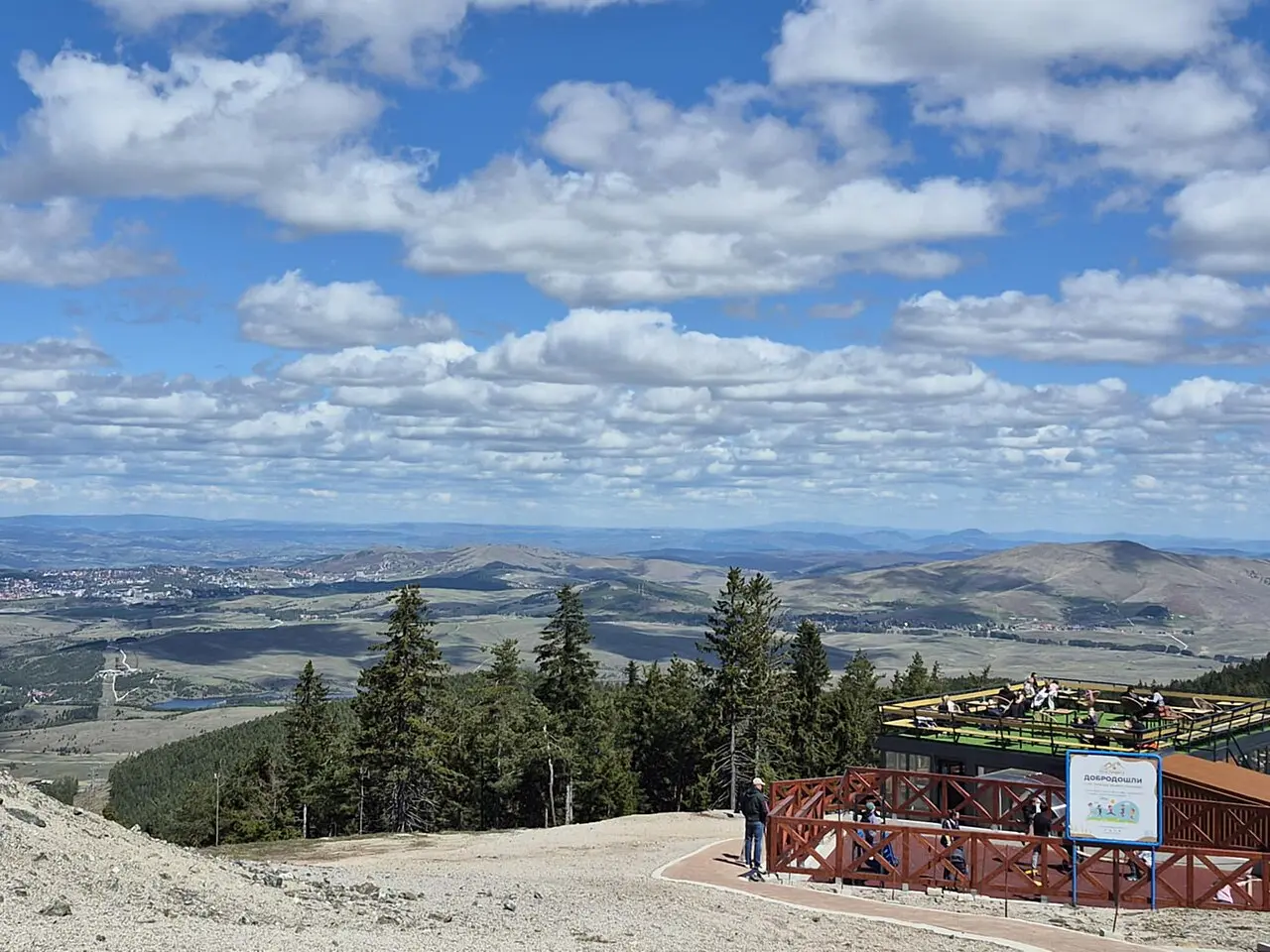
The numbers behind it are worth knowing. It opened in January 2021, runs a fleet of 72 ten-seat cabins (with room to grow to 90), and takes roughly 25 to 30 minutes end to end, gliding over Lake Ribničko and the forest on the way up. The top station sits on Tornik at 1,496 metres - the highest point on the mountain - where in summer you get big views and a scatter of walking trails, and in winter the lifts and pistes of Zlatibor’s ski area. It runs year-round.
One thing I’ll level with you on: there’s no ticket price here because the operator publishes no list. Where an operator does publish one we quote it and say which season it belongs to, as our Kopaonik accommodation guide does with that resort’s lift passes; for the Gold Gondola there is nothing to quote, so check the current single and return fares on the day. In high summer and over New Year it gets busy, so going early pays off.
Tornik, hiking and the ski season
Whether you ride up or drive up, Tornik is Zlatibor’s high point in every sense. In summer it’s a launch pad for easy plateau walks through pine and meadow - this is soft, welcoming hiking country, not scrambling terrain, which is exactly its appeal for families and casual walkers. The wider mountain is laced with marked trails and, increasingly, cycling routes; you can pedal (or walk sections) all the way out toward Sirogojno and the Mokra Gora side.
In winter Tornik becomes Zlatibor’s ski centre - a modest but real ski area with a handful of runs served by the gondola and chairlifts, popular with Belgraders for a weekend on the snow. It’s not the Alps and it isn’t Kopaonik, Serbia’s biggest and highest ski resort, but it’s friendly, easy to reach and cheaper, and the gondola means you can go up for the views even if you don’t ski. If you’re torn between the two mountains, our Zlatibor or Kopaonik comparison lays out which suits which trip. Snow cover is never guaranteed this far south and this low, so it pays to check conditions before you commit to a ski trip.
Sirogojno and the Old Village museum
The cultural set-piece of the area is Sirogojno, a village about half an hour east of the resort that’s home to the “Staro selo” (Old Village) open-air museum - an ethno-village of genuine 19th-century timber buildings gathered from across the Zlatibor region and rebuilt on a wooded hillside. Spread over roughly five hectares, it’s a proper working reconstruction of old highland life: log houses with steep shingled roofs, a dairy, a bakery, an inn, outbuildings and a little church, arranged as a zadruga (the extended-family homestead that once organised life up here).
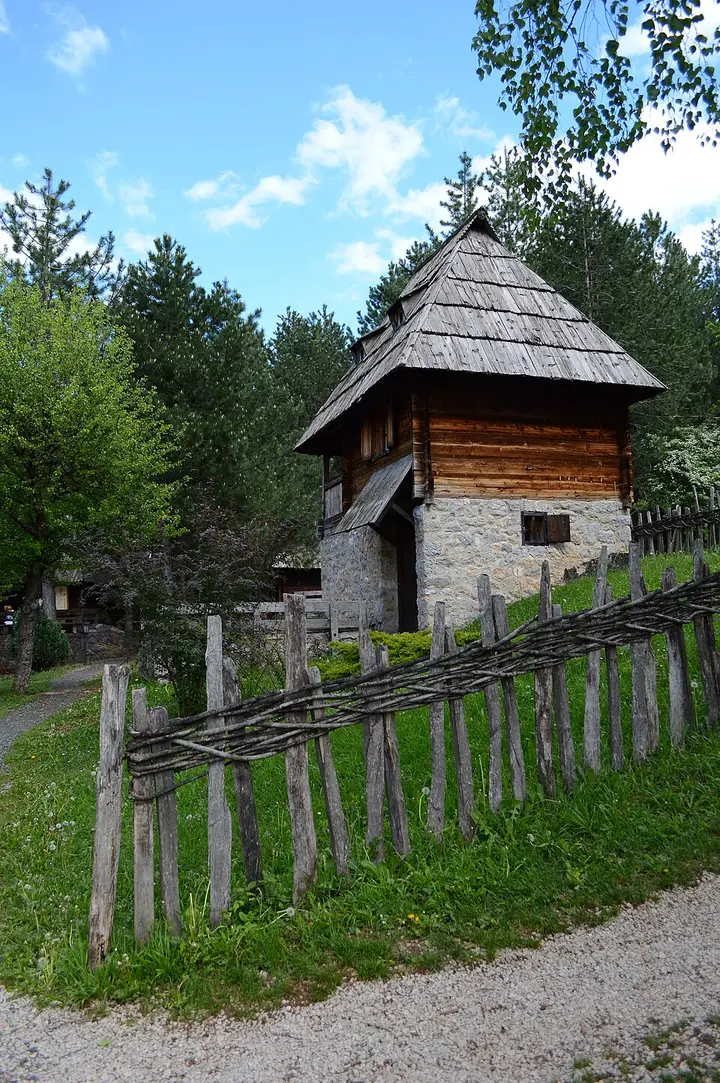
It’s more than a photo stop. The museum runs workshops and a restaurant, and Sirogojno has a second claim to fame - its hand-knitted wool sweaters, the “Sirogojno style” that grew into a genuine fashion label in the socialist era and still trades on that heritage. Give it an hour or two, combine it with lunch, and it makes one of the most rewarding easy half-days on the mountain - a real sense of how people lived up here before the hotels arrived.
Stopića Cave and the plateau’s quirks
For an underground outing, head to Stopića Cave (Stopića pećina), on the Rožanstvo side of the plateau above the Prištavica river. It’s one of western Serbia’s biggest show caves, entered through a vast mouth 18 metres high and 35 metres wide, and its signature sight is a run of terraced tufa pools - natural stone basins the locals call bigrene kade, “travertine bathtubs” - fed by a waterfall that drops around 10 metres inside the cave when the water is high. A lit walkway takes you through several chambers; bring a layer, because it’s cool and damp underground whatever the weather outside.
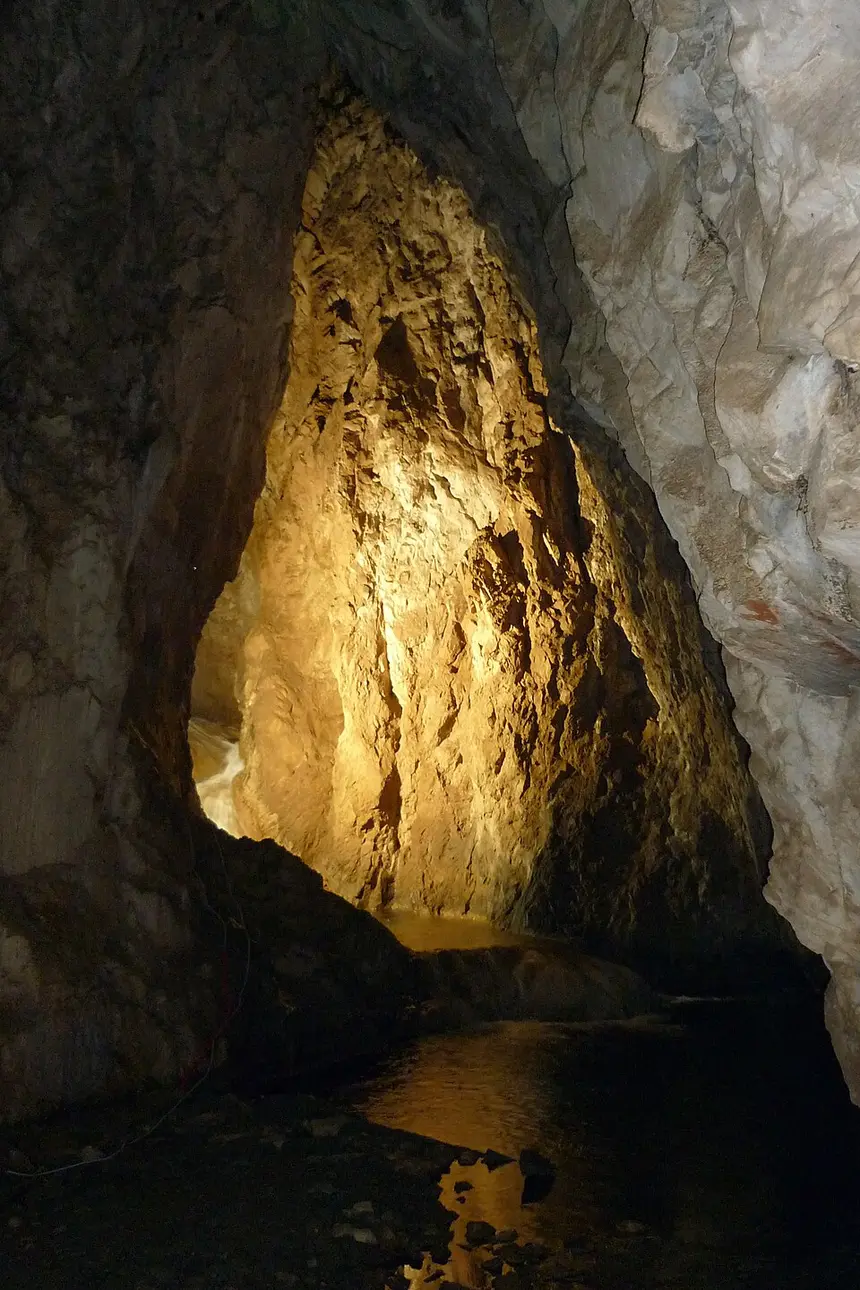
The cave pairs naturally with Sirogojno (they’re on the same side of the mountain) and with a swing out toward Mokra Gora, so many people string all three into one loop. If you’re building a route, it slots neatly between the ethno-village and the Šargan railway.
Ham, cheese and the Zlatibor table
Don’t leave without eating properly, because this is one of Serbia’s great food regions. Zlatibor is smoked-meat and dairy country, and the star is its cured ham - Zlatiborska/Užička pršuta, made the old way from beef or pork that’s salted, cold-smoked over beech wood and air-dried for about a month in the mountain air. The village of Mačkat, just off the road, is the acknowledged capital of it (and of spit-roasted lamb), and the ham is on the track to formal protected-origin status, alongside Italian and Spanish cousins.
The other half of the plate is dairy: kajmak (a rich, clotted-cream spread that goes on everything), young cheeses, and the semi-hard Zlatar cheese from the neighbouring mountain, all often served in a komplet lepinja - a fresh flatbread soaked in kajmak and drippings that is exactly as indulgent as it sounds. Look for a domaćinstvo or mountain konoba rather than a hotel buffet, order a board of pršuta and cheese with a rakija, and you’ve understood Zlatibor as well as any gondola will teach you.
Spas, wellness and taking it easy
A big slice of Zlatibor’s appeal is simply doing very little in comfort. The plateau has long been known as an air spa - its clean, dry mountain air was historically prescribed for people with respiratory and thyroid complaints, and the local Čigota clinic still runs health and weight programmes on that reputation (all of which is context, not medical advice - take health decisions with a doctor, not a travel guide). What that heritage has left is an unusually deep bench of spa and wellness hotels: pools, saunas, hammams and treatment centres are standard here in a way they aren’t in most of Serbia.
For a lot of visitors that’s the whole point - a couple of nights of mountain air, a spa afternoon, a long lunch of ham and kajmak, and one good outing to the gondola or Sirogojno. It’s an easy, restorative kind of trip, and a good reason to book a hotel with its own wellness centre rather than just a bed. For which part of the resort to base yourself in, and how the central lake, the quiet pines and the outlying villages differ, our guide to where to stay in Zlatibor breaks down the zones and what each one costs.
Using Zlatibor as a base for western Serbia
Here’s where Zlatibor really earns its keep. Because it has the region’s best spread of hotels, restaurants and services, it makes the ideal base for the properly spectacular stuff nearby - none of which has anything like Zlatibor’s infrastructure of its own.
- Tara National Park - the Drina canyon and the Banjska Stena viewpoint, one of the great sights of Serbia, are roughly 40-60 minutes to the park approaches by road (allow up to about 1-1.5 hours door-to-door for the viewpoint spur); plenty of people sleep on Zlatibor and do Tara, plus the marooned house on the Drina near Bajina Bašta, as a day out.
- The Šargan Eight railway and Mokra Gora - the famous narrow-gauge figure-eight line and Kusturica’s wooden village of Drvengrad are a short drive up the road, an easy half-day.
- Sirogojno and Stopića Cave - both on the plateau itself, as above, and combinable into a single loop.
- Uvac Canyon - the famous river meanders and the Balkans’ biggest griffon vulture colony, about an hour southeast; a popular full-day boat-and-viewpoint tour from the mountain, or the start of our two-day Uvac, Zlatar and Mileševa loop if you want to keep driving south.
Give Zlatibor two or three nights and you can fold in the gondola, the ethno-village and the cave, plus a full day at Tara and a morning on the Šargan railway, without ever changing hotel. For getting between them all you’ll want a car - our four-day western Serbia loop is really a driving trip - and for the resort itself, book a spa hotel and let the mountain do the rest. Not sure how the west fits into a wider trip? Our guide to how many days you need in Serbia shows where the mountains sit in a week or ten days.
When to go
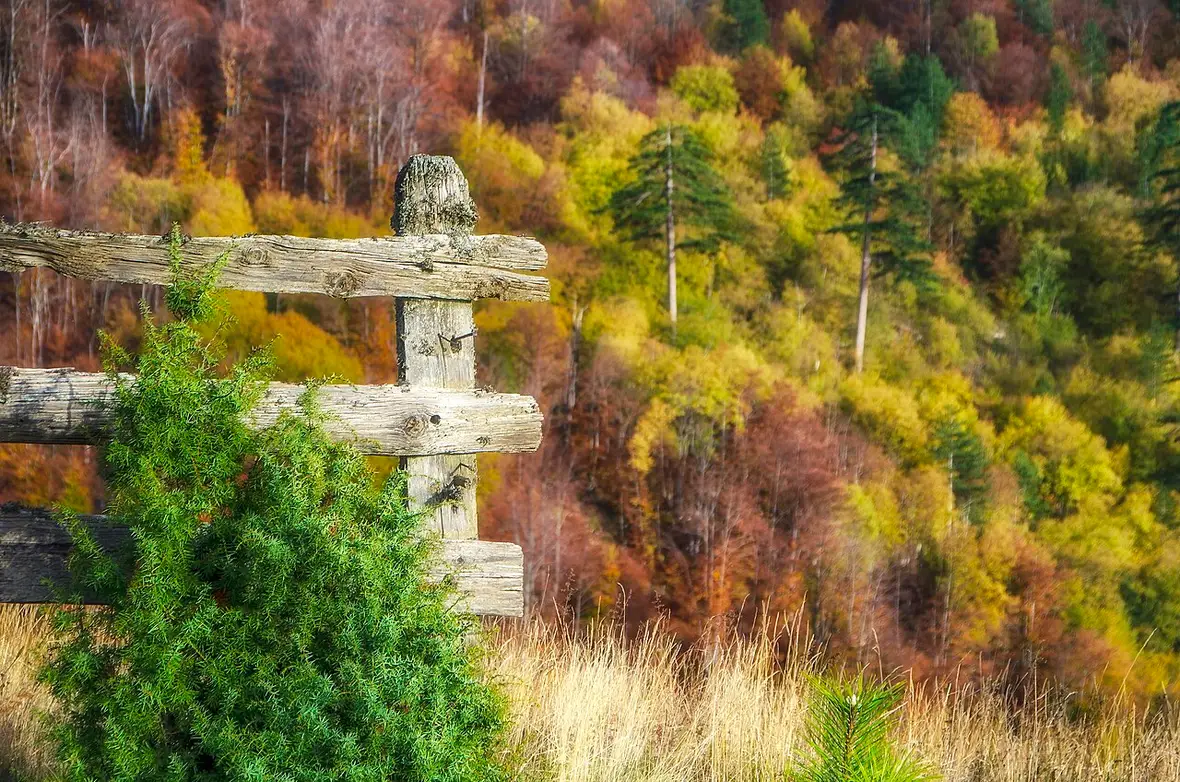
The plateau is a year-round resort, which is part of its charm. Summer (June-September) is the peak: warm but rarely fierce at altitude, long days, everything open, and the meadows and forest at their best for walking and cycling - it’s also the busiest and priciest stretch, so book ahead. Late spring and early autumn are arguably the sweet spot, quieter and lovely, with autumn turning the beech and meadow gold. Winter brings the ski season on Tornik and a cosy, spa-and-snow kind of holiday, especially around New Year when the resort fills up - just don’t count on deep snow this far south, and see Serbia in winter for the Tornik pass prices and which week is worth booking. Whenever you come, pack a warm layer: it’s a good deal cooler up here than down in Belgrade, and mountain evenings bite even in July. For how the mountain fits the rest of the country’s calendar, see our guide to the best time to visit Serbia.
Zlatibor is, in the end, the comfortable heart of western Serbia - not the region’s most dramatic sight, but the place you sleep, eat and set out from to reach the ones that are. It’s the western base on both our 7-day and 10-day Serbia road trips, if you’re building the mountain into a bigger loop. Browse more of the country’s mountains and landmarks in the attractions section, and give the mountain a couple of unhurried days: the gondola, a plate of pršuta and a spa afternoon are only ever a short drive from the Drina canyon.
Photos
On the map
The map loads on click - to keep the page lightweight.
The map didn’t load. Check your connection and refresh the page.
Distance ≈230 km · ~3-3.5 h by car
- Belgrade ≈230 km · ~3-3.5 h by car E763 motorway southwest toward Užice, then the short climb up to the plateau - an easy half-day drive.
Read also

Cities · 9 min read
Sombor: Vojvodina's Greenest Town
Verified · August 31, 2026Sombor travel guide: 121 km of tree alleys, the fijaker stand, County Hall with Eisenhut painting, and Gornje Podunavlje wetlands.

Cities · 12 min read
Valjevo: Old Town, Museums and Two Rivers
Verified · August 19, 2026Valjevo travel guide: Tesnjar, the Muselim Residence, Nenadovic Tower, the cathedral, and how to reach the town by train or car.

Cities · 9 min read
Sokobanja: Spa Under Rtanj Mountain
Verified · August 13, 2026Sokobanja spa guide: Ottoman hammam, respiratory air, Rtanj hikes, Bovan Lake and how to reach the town from Niš or Belgrade.

Cities · 10 min read
Vrnjacka Banja: Serbia's Top Spa Town
Verified · July 25, 2026Vrnjacka Banja is Serbia's most visited spa town: seven mineral springs, the Bridge of Love padlocks, a green park and Lovefest each August.